

CG Policy · 2025
In this section7 topics
Corporate Governance Policy
Has a Corporate Governance Policy
Yes
Policy Description
Chuwit Farm (2019) Public Company Limited has established a corporate governance policy in accordance with the principles of good corporate governance for listed companies 2016 of the Securities and Exchange Commission, to be used as a guideline in conducting business and managing the organization to create sustainable value for the business. There are 8 good corporate governance practices as follows:
Principle 1 : Establish Clear Leadership Role and Responsibilities of the Board
(1) The Board of Directors understands its role and responsibilities as a leader in overseeing good corporate governance. The Company has established a Board of Directors' Charter, which clearly defines the authority and responsibilities of the Board of Directors, both in performing its duties and overseeing the Company's business to comply with laws, objectives, rules, resolutions of the Board of Directors' Meeting, and resolutions of the Shareholders' Meeting, with responsibility, prudence, honesty, and integrity to protect the rights and interests of all shareholders.
(2) The Board of Directors is responsible for setting the objectives, vision, mission, policies, key targets, and business strategies of the Company, as well as overseeing the management and operations of the Company's management to comply with the policies, objectives, plans, and budgets set for the best interests of the Company and shareholders.
(3) The Board of Directors has established various policies, such as the Corporate Social Responsibility Policy, the Anti-Corruption Policy, and the Code of Business Conduct, to ensure that the Company conducts its business ethically, for the benefit of society and the environment, and is adaptable to changing factors to create sustainable value for the business. The Board of Directors will monitor the Company's compliance with these policies, including posting them at the Company for executives and employees to acknowledge and comply with, and communicate them to ensure understanding and effective implementation. In addition, the Board of Directors is responsible for reviewing and revising these policies to ensure that they are consistent with current circumstances.
(4) The Board of Directors is responsible for establishing adequate systems and mechanisms to ensure that the operations of the Company and its subsidiaries (if any) comply with laws, objectives, articles of association, resolutions of the Board of Directors' Meeting, resolutions of the Shareholders' Meeting, and the Company's policies.
(5) The Board of Directors has established sub-committee charters that clearly define the authority and responsibilities of each sub-committee. In addition, the Board of Directors is also responsible for updating the contents of the Board of Directors' Charter and the sub-committee charters to be consistent with current conditions, regulations, rules, and changing circumstances.
Principle 2 : Define Objective that Promote Sustainable Value Creation
The Board of Directors has established the objectives and key targets of the organization in conducting business to ensure sustainability and consistency with creating value for the business, customers, all stakeholders, and society as a whole. The Board of Directors has also communicated these objectives and targets to personnel at all levels to serve as a guideline in performing their duties to achieve the established objectives and targets and to foster the organizational culture.
In addition, the Board of Directors will promote the adoption of new technologies and innovations to ensure that the business operates in accordance with the established policies effectively, as well as require the review of objectives, targets, and strategic plans annually to ensure that they are consistent with the economic conditions, the organization's potential, and the key objectives of the business, with close monitoring and evaluation.
Principle 3 : Strengthen Board Effectiveness
The Company has a policy to establish a Board structure that is appropriate and consistent with the business and size of the Company and in accordance with the law, as follows:
(1) The Board of Directors consists of individuals with diverse qualifications, both in terms of knowledge, abilities, and experience that can benefit the Company.
(2) The Board of Directors consists of seven (7) members, comprising four (4) executive directors and three (3) independent directors, which is more than one-third (1/3) of the total number of directors, thus ensuring an appropriate balance in the consideration and voting on various matters. All independent directors of the Company meet the qualifications stipulated in the Notification of the Capital Market Supervisory Board, the Rules of the Stock Exchange of Thailand, as well as other relevant rules, regulations, and laws.
(3) The Nomination, Remuneration and Corporate Governance Committee is responsible for recruiting individuals with appropriate knowledge, expertise, and experience who can perform duties that are beneficial to the Company's business, to be presented to the Board of Directors' Meeting and/or the Shareholders' Meeting (as the case may be) for consideration of appointment as directors of the Company and sub-committees. After the Company is listed on the Stock Exchange of Thailand, the Company will disclose information of the Board of Directors and sub-committees, such as age, gender, education, experience, shareholding, number of years in office, number of meetings attended, remuneration of the Board of Directors, both monetary and non-monetary, directorships in other listed companies, roles, responsibilities, and performance reports of the Board of Directors and sub-committees in the Company's annual report and/or on the Company's website.
(4) The Board of Directors has a term of office of no more than three (3) years in accordance with relevant laws.
(5) Directors and executives of the Company may serve as directors or executives of affiliated companies or other companies, but such positions must not interfere with their duties as directors of the Company and must comply with the regulations of the Securities and Exchange Commission, the Capital Market Supervisory Board, and the Stock Exchange of Thailand, as well as other relevant rules, regulations, and laws. They should attend no less than seventy-five percent (75%) of all Board of Directors' meetings held in each year.
(6) The Chairman of the Board and the Managing Director of the Company will not be the same person to ensure clarity in the responsibilities between policy setting, oversight, and day-to-day management. The Company has clearly defined the authority, duties, and responsibilities of the Managing Director.
(7) The Board of Directors has appointed sub-committees to support the work of the Board of Directors and the operations of the Company, namely the Audit Committee, the Executive Committee, the Nomination, Remuneration and Corporate Governance Committee, and the Risk Management Committee. The Board of Directors has also established charters for each sub-committee to clearly define the authority and responsibilities of each sub-committee, and has required that these charters be reviewed to ensure that they are consistent with current circumstances, as follows:
(7.1) The Audit Committee consists of at least three (3) audit committee members to assist the Board of Directors in overseeing and monitoring the management, internal control, and compliance with relevant laws, as well as the preparation of financial statements to ensure that the Company's operations and disclosures are transparent and credible. The details of the composition, qualifications, authority, and responsibilities are specified in the Audit Committee Charter.
(7.2) The Executive Committee consists of at least three (3) executive committee members to assist the Board of Directors in managing the Company's business in accordance with policies, plans, rules, and any orders, including the objectives set, within the framework assigned by the Board of Directors. The details of the composition, qualifications, authority, and responsibilities are specified in the Executive Committee Charter.
(7.3) The Nomination, Remuneration and Corporate Governance Committee consists of at least three (3) members to recruit qualified individuals to serve as directors of the Company, sub-committees, and Managing Director, as well as to consider the remuneration policy, remuneration structure, and remuneration of the Board of Directors, sub-committees, and Managing Director, to submit its recommendations to the Board of Directors and/or to the Shareholders' Meeting for approval. The details of the composition, qualifications, authority, and responsibilities are specified in the Nomination, Remuneration and Corporate Governance Committee Charter.
(7.4) The Risk Management Committee consists of at least three (3) members to establish risk management policies covering the entire organization, based on the principles of good corporate governance and the COSO Enterprise Risk Management Framework (COSO ERM), to oversee the management of the Company's business to have a risk management process in place to mitigate the impact on the Company's business appropriately. The details of the composition, qualifications, authority, and responsibilities are specified in the Risk Management Committee Charter.
(8) The Company has appointed a company secretary to perform duties related to the meetings of the Board of Directors and shareholders' meetings, as well as to support the work of the Board of Directors by providing advice on legal requirements and regulations related to the duties of the Board of Directors.
(9) The Company has stipulated in the Board of Directors' Charter and the Sub-Committees' Charter that each committee is responsible for evaluating the annual performance of the Board of Directors and sub-committees as a whole and individually, including requiring the sub-committees to report the evaluation results to the Board of Directors for consideration annually. The performance evaluation of the Board of Directors will be disclosed in the annual report.
Principle 4 : Ensure Effective CEO and People Management
(1) The Nomination, Remuneration and Corporate Governance Committee is responsible for determining the qualifications and criteria for recruiting suitable individuals to serve as Managing Director, as well as setting the policy framework and remuneration structure for the Managing Director, to be submitted to the Board of Directors for approval. The Committee is also responsible for considering the format, plan, and process for developing the Managing Director to be in line with the Company's business, economic conditions, technology, laws, or regulations related to the Company's business, such as training to develop knowledge and performance evaluation.
(2) For senior executives who hold positions below the Managing Director, the Managing Director has the authority to determine the criteria for recruiting individuals to serve as senior executives and the policy framework and remuneration structure for senior executives, to be submitted to the Board of Directors for approval. The Managing Director also has the authority to appoint, determine the remuneration of, and evaluate the performance of such individuals.
(3) The Board of Directors has established a Succession Plan to prepare for the succession of the Managing Director and senior management with the objective of ensuring the continuity of the Company's business.
(4) The Board of Directors will oversee the establishment of appropriate compensation structures and performance evaluations, the management and development of personnel to have appropriate knowledge, skills, experience, and motivation, and will ensure that human resources are managed in line with the direction and strategies of the business, encourage employees to participate in training to enhance their knowledge and abilities, and oversee the fair treatment of employees to retain talented personnel.
(5) The Board of Directors will oversee the Company's provision of a provident fund to enable employees to save adequately for retirement, as well as support employees' understanding of financial management to ensure that employees have a good quality of life and can work with the Company in the long term.
Principle 5 : Nurture Innovation and Responsible Business
The Board of Directors prioritizes and supports the creation of innovations that add value to the business while creating benefits for customers or stakeholders and being responsible for society and the environment. The Board of Directors also ensures that management allocates and manages resources efficiently and effectively, taking into account the impact and development of resources to achieve the objectives and key targets of the business sustainably.
The Board of Directors will establish a framework for overseeing and managing information technology at the organizational level that is consistent with the needs of the Company, as well as ensure that information technology is used to enhance business opportunities, develop operations, and manage risks so that the Company can achieve its objectives and key targets.
In addition, the Company has taken into account the rights of all stakeholders by establishing a written Code of Business Conduct for the Board of Directors, executives, and employees of the Company to adhere to as a guideline in performing their duties as representatives of the Company, as follows:
Shareholders : The Company will conduct business with transparency and efficiency to create sustainable value for the business by striving to create good operating results and stable growth to maximize shareholder benefits in the long term, including disclosing information transparently and reliably to shareholders, as well as not committing any unlawful acts that violate or infringe upon the rights of shareholders, and treating all shareholders fairly and equally.
Employees : The Company will treat all employees equally, fairly, and provide appropriate compensation, as well as maintain a working environment that takes into account quality of life and safety at work, and adheres to labor laws. In addition, the Company also attaches importance to the development of skills, knowledge, abilities, and potential of employees on a regular basis, such as organizing training, seminars, and workshops, providing equal opportunities to all employees, and trying to create incentives for highly skilled employees to stay with the Company to develop the organization further. The Company has also established guidelines to combat corruption, as well as instilling in all employees to comply with relevant laws and regulations, such as strictly prohibiting the use of inside information.
Business Partners : The Company has a process for selecting business partners by allowing them to compete on an equal footing and selecting them fairly under the Company's transparent partner evaluation and selection criteria. In addition, the Company has established appropriate and fair contract templates for all parties and has a monitoring system in place to ensure that the terms of the contracts are fully complied with and to prevent fraud and misconduct at every step of the procurement process. The Company purchases goods from business partners in accordance with commercial terms and conditions and complies with contracts with business partners.
Creditors : The Company will comply with the terms and conditions of the contracts with creditors, including the repayment of principal, interest, and collateral under the relevant contracts.
Competitors : The Company conducts its business ethically, within the framework of fair competition, and in compliance with the law, as well as supporting and promoting free and fair competition policies.
Community and Society : The Company cares about and prioritizes the safety of society, the environment, and the quality of life of people involved in the Company's operations, and encourages its employees to be aware of and responsible for the environment and society, as well as ensuring compliance with relevant laws and regulations. In addition, the Company strives to participate in various activities that create and preserve the environment and society, as well as promote the culture of the local communities where the Company operates. In addition, stakeholders can inquire about details, file complaints, or report illegal activities or ethical violations in the Company's business conduct through the channels designated by the Company. All complaints and reports submitted to the Company will be kept confidential by the persons designated by the Company to investigate the information and find solutions (if any) and/or consider submitting important complaints with comments to the Board of Directors for further consideration.
Principle 6 : Strengthen Effective Risk Management and Internal Control
(1) To ensure that the Company has an effective risk management system, the Board of Directors has appointed a Risk Management Committee to assist the Board of Directors in establishing appropriate risk management policies covering the entire organization and to ensure that there is an effective and efficient overall risk management system or process in place to manage risks to an acceptable level. The Risk Management Committee has the following authority and responsibilities, including:
(1.1) Assess and review the nature of risks that the company is facing or is expected to face and impact the company (Identification of Risk) and determine the company's acceptable risk level (Risk Appetite).
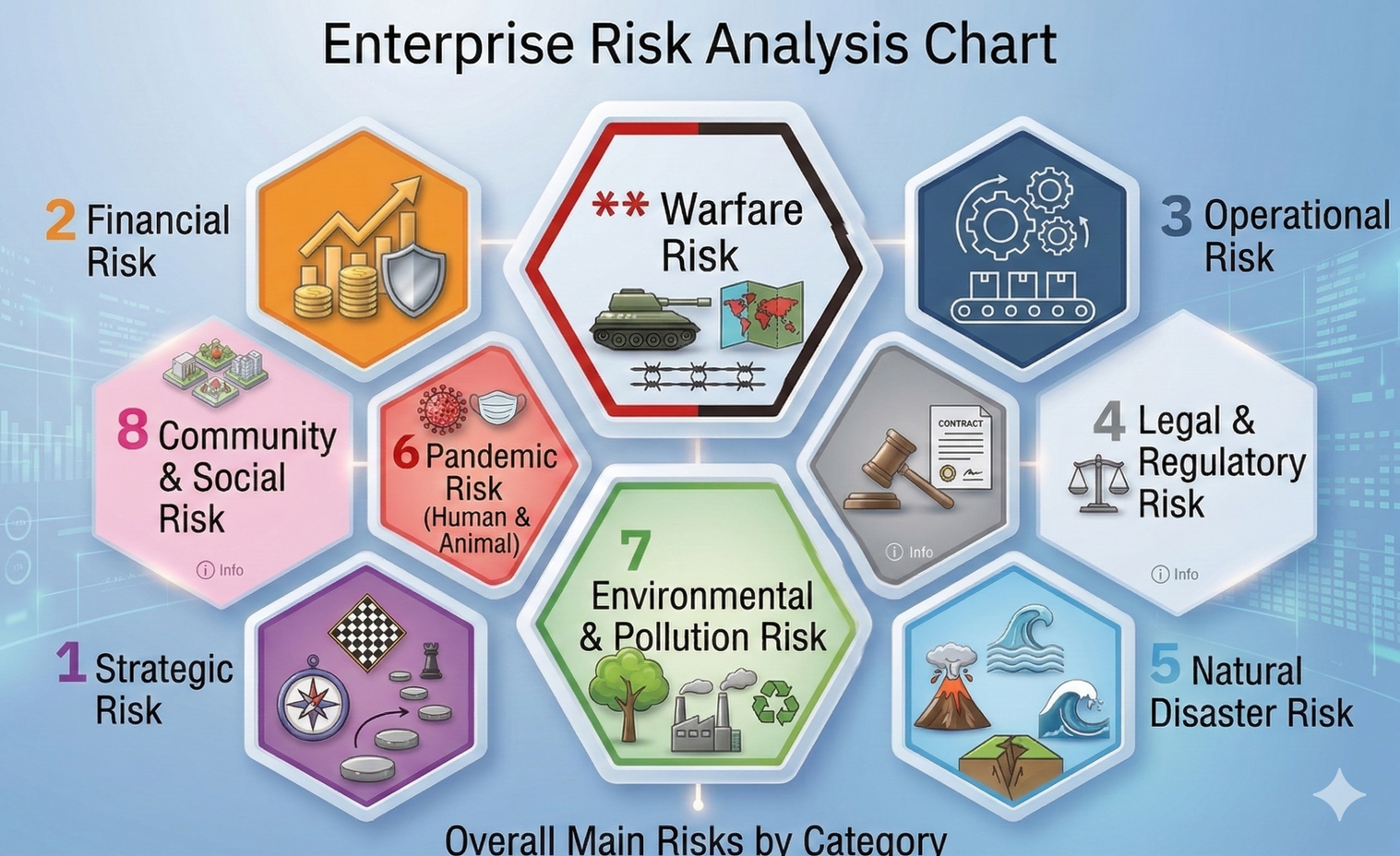
(1.2) The Company has a policy to identify and analyze risks by considering internal and external factors that have occurred or may occur that may affect the operations or hinder the achievement of the Company's objectives, which are comprehensively identified in all 8 areas In 2025, one additional risk was identified: war-related risk, particularly in Thailand’s border areas, as detailed below.
1) Strategic Risks
2) Financial Risks
3) Operational Risks
4) Legal and Regulatory Risks
5) Natural Disaster Risks
6) Epidemic Risks, Both Human and Animal
7) Environmental and Pollution Risks
8) Community and Social Risks
**Risk of War or Armed Conflict
(1.3) Establish strategies and guidelines for risk management in accordance with the risk management policy to enable assessment, monitoring, and control of risk levels to an acceptable level.
(1.4) Report to the Board of Directors on risks and risk management. The authority and responsibilities of the Risk Management Committee are specified in the Risk Management Committee Charter.
(2) The Board of Directors has appointed an Audit Committee with qualifications as prescribed by relevant laws and regulations to perform various duties, including reviewing and/or considering financial statements, the adequacy of the internal control system, compliance with laws, the independence of the internal audit function, the selection of auditors, and the Company's disclosures.
(3) In addition to the Audit Committee's responsibilities in overseeing conflicts of interest, the Company has also established a Conflict of Interest Policy to provide guidelines for handling conflicts of interest.
(4) The Company has established a Code of Business Conduct and an Insider Trading Policy to prevent the misuse of the Company's assets, information, and opportunities. The Company has also established a Related Party Transaction Policy to prevent related party transactions that are inappropriate or not in accordance with relevant regulations.
(5) The Board of Directors has established a clear anti-corruption policy that is communicated to all levels of the organization and external parties to ensure effective implementation. The Board of Directors will establish anti-corruption projects or guidelines, as well as support activities that promote and instill in all employees compliance with relevant laws and regulations. The Company has also established a whistleblowing and investigation process, and has established clear guidelines in its anti-corruption policy. The Company has established a variety of communication channels to provide employees and stakeholders with convenient and appropriate ways to report concerns or complaints to the Company. The Company has established measures to protect whistleblowers, complainants, witnesses, and those who provide information in investigations from any harm, threats, or unfair treatment arising from whistleblowing, complaints, testimony, or providing information to the Company.
(6) The directors and executives of the Company are required to report to the Company any conflicts of interest of themselves or related persons that are related to the management of the Company's business. The Company has stipulated the duty to report conflicts of interest of directors in the Board of Directors' Charter, which requires directors to notify the Company without delay in the event that any director has a conflict of interest in any transaction with the Company or has a change in shareholding in the Company.
Principle 7 : Ensure Disclosure and Financial Integrity
(1) The Board of Directors shall ensure that the company has an accounting system, financial reporting, and financial statement audit in accordance with relevant rules, regulations, and practices. The Board shall also ensure that the company discloses various information, including company information, financial information, and important general information, accurately, adequately, timely, and in accordance with relevant laws, rules, and regulations.
(2) The Board of Directors is responsible for preparing the annual report, the Annual Registration Statement (Form 56-1), and the Company's financial statements, prepared in accordance with generally accepted accounting standards and using careful judgment in their preparation, including requiring the disclosure of significant information in the notes to the financial statements. The Audit Committee oversees the quality of the financial statements and provides its opinion to the Board of Directors.
(3) The Board of Directors is responsible for overseeing the adequacy of the Company's financial liquidity and debt service capacity. The Board of Directors will establish a plan or guidelines to address any problems that may arise. The Board of Directors requires management to monitor and assess the Company's financial position and liquidity on a regular basis and report to the Board of Directors on a quarterly basis.
(4) The Company will have an investor relations department or officer to communicate and provide information to shareholders, investors, securities analysts, or related agencies, as well as any person, to ensure appropriate, equal, and timely communication.
(5) The Board of Directors will promote the use of information technology to disseminate information. In addition to disclosing information in accordance with the regulations through the channels of the Stock Exchange of Thailand, the Board of Directors will also disclose information in both Thai and English through other channels, such as the Company's website, and present up-to-date information.
Principle 8 : Ensure engagement and Communication with Shareholders
The Board of Directors recognizes and prioritizes the fundamental rights of shareholders, both as investors in securities and owners of the Company, such as the right to buy, sell, and transfer their securities, the right to receive dividends from the Company, the right to receive adequate information, the right to attend meetings to exercise voting rights at the Shareholders' Meeting to appoint or remove directors, appoint auditors, approve material transactions that affect the Company's business direction, and matters that affect the Company, such as dividend payments, amendments to the Memorandum of Association and Articles of Association, capital reductions or increases, and the approval of special items. The Company is committed to promoting and facilitating the exercise of shareholder rights, including treating all shareholders equally, as follows:
(1) Provide information on the date, time, venue, and agenda of the meeting, with explanations, reasons, and the Board of Directors' opinions on each agenda item or proposed resolution as specified in the notice of the Shareholders' Meeting or in the accompanying documents to the agenda items completely and sufficiently for shareholders to make decisions. The notice of meeting will be sent to shareholders and the Stock Exchange of Thailand, and the notice of meeting will be published on the Company's website in accordance with the criteria, regulations, and other relevant laws. The Company will refrain from any actions that limit shareholders' opportunities to access the Company's information.
(2) Facilitate all shareholder groups to fully exercise their rights to attend meetings and vote, and refrain from any actions that limit shareholders' opportunities to attend meetings, such as using a convenient venue, by attaching a map showing the venue of the shareholders' meeting in the notice of meeting, as well as choosing an appropriate date and time and allocating sufficient time for the meeting to make attendance and voting convenient and not overly expensive.
(3) Prior to the Shareholders' Meeting, the Company will provide an opportunity for shareholders to submit their opinions, suggestions, questions, or propose additional agenda items in advance by establishing clear guidelines for submitting questions and proposing agenda items in advance and informing shareholders along with the delivery of the notice of the Shareholders' Meeting. The Company will publish such guidelines on the Company's website.
(4) Establish criteria and procedures for minority shareholders to nominate individuals to serve as directors of the Company, and disclose information on the qualifications and consent of the nominees on the Company's website.
(5) Encourage shareholders to use proxy forms that allow them to specify their voting instructions and to nominate at least one independent director as an option in their proxies.
(6) Before the commencement of the Shareholders' Meeting, the Chairman of the Meeting will explain to the shareholders the rules of the meeting, the voting procedures, the voting rights of each class of shares, and the vote counting method for each agenda item.
(7) At the Shareholders' Meeting, the Chairman of the Meeting will allocate appropriate time and the Company will provide equal opportunities for all shareholders to express their opinions, suggestions, or ask questions on relevant agenda items freely before voting on any agenda item.
(8) The Company will encourage all members of the Board of Directors and senior management of the Company to attend the Shareholders' Meeting to answer shareholders' questions.
(9) Provide for voting on each agenda item at the Shareholders' Meeting in the event that there are multiple items on the agenda, such as the agenda item on the election of directors.
(10) The Company will encourage the use of ballot papers for transparency and verifiability in vote counting.
(11) The Company will have an independent person act as a scrutineer or vote counter for each agenda item and disclose this to the meeting, as well as record it in the minutes of the meeting.
(12) After the Shareholders' Meeting, the Company will prepare minutes of the meeting that accurately and completely record the important details, including recording the questions, comments, and important suggestions in the minutes of the meeting for shareholders to review. In addition, the Company will disclose the voting results for each agenda item, as well as the minutes of the meeting, on the Company's website for shareholders to consider.
(13) The Company will submit a copy of the minutes of the Shareholders' Meeting to the Stock Exchange of Thailand within 14 days from the date of the Shareholders' Meeting.
(14) Encourage the Company to use technology for shareholders' meetings, including shareholder registration, vote counting, and display, to ensure that the meeting can be conducted quickly, accurately, and precisely. The Company will review its corporate governance policy annually to ensure that it is consistent with the Company's circumstances and business.
Policy & Practices — Board of Directors
Has Policy & Guidelines for the Board
Yes
Board Guidelines
| Guideline | Detail |
|---|---|
| Nomination of Directors | The Nomination and Remuneration Committee is responsible for considering and establishing criteria and processes for recruiting qualified individuals to be appointed as directors and top executives of the company. This includes considering the form and criteria for remuneration to be proposed to the Board of Directors and the shareholders' meeting for approval as required by law. The committee also supports the Board of Directors in establishing corporate governance policies and guidelines in various areas to align with good corporate governance principles. It also promotes and supports personnel at all levels of the company to adhere to good corporate governance principles and business ethics. This ensures the company's sustainable growth through efficient, transparent, accountable, and socially and environmentally responsible business operations, which will enhance the confidence of shareholders, investors, stakeholders, and all parties involved. |
| Determination of Director Remuneration | (1) The Nomination, Remuneration and Corporate Governance Committee is responsible for determining the qualifications and criteria for the recruitment of suitable persons to serve as the Managing Director, including determining the policy framework and form of remuneration for the Managing Director to be proposed to the Board of Directors for approval, and is responsible for considering the form, plan, and process for the development of the Managing Director to be in line with the Company's business, economic conditions, technology, laws or regulations related to the Company's business, such as training to develop knowledge and performance evaluation. (2) For senior executives holding positions below the Managing Director, the Managing Director has the authority to determine the criteria for the recruitment of persons to hold senior executive positions and the policy framework and form of remuneration for senior executives to be proposed to the Board of Directors for approval, including the authority to appoint, determine the remuneration, and evaluate the performance of such persons. (3) The Board of Directors has established a Succession Plan to prepare for the succession of the Managing Director and senior executives, with the objective of ensuring the continuity of the Company's business. (4) The Board of Directors will ensure that appropriate remuneration structures and performance evaluations are in place, that human resources are managed and developed to have appropriate knowledge, skills, experience and motivation, and that human resources are managed in line with the direction and strategies of the business, encouraging employees to participate in training to enhance their knowledge and abilities, and ensuring that employees are treated fairly in order to retain talented personnel. (5) The Board of Directors will ensure that the Company has a provident fund to enable employees to save adequately for retirement and will support employees in gaining knowledge and understanding of financial management in order for employees to have a good quality of life and work with the Company in the long term. |
| Board Performance Evaluation | 1. According to the good corporate governance for listed companies, it is recommended that the board of directors and sub-committees of listed companies should conduct a self-evaluation of their performance at least once a year. This is to allow the board to jointly consider performance and make improvements. The evaluation should be conducted both as a board and individually. 2. To promote and support listed companies to conduct annual board and sub-committee evaluations on a regular basis. The board self-assessment forms are divided into 4 types as follows: • Document Set 1 “Board Self-Assessment Form” to be used to assess the overall performance of the board. • Document Set 2 “Concise Board Self-Assessment Form” suitable for listed companies that have recently started conducting evaluations. • Document Set 3 “Sub-Committee Self-Assessment Form” to be used to assess the performance of sub-committees assigned by the Board of Directors in terms of the overall board. • Document Set 4 “Individual Director and Sub-Committee Evaluation Form” to be used to assess the proper performance of individual directors. The four types of assessment forms can be adapted by listed companies to suit their environment and business. |
Code of Conduct
Has a Business Code of Conduct
Yes
Code of Conduct Description
ChuwitFarm (2019) Public Company Limited adheres to Business Ethics towards its stakeholders, including customers, employees, shareholders, partners, and society. The company operates with honesty and transparency, refraining from using false or misleading information in business decisions. Financial disclosures and activities are conducted accurately, without concealing important information from stakeholders. Fairness is paramount in business operations, treating all parties equitably without discrimination. Regardless of their status, all stakeholders are treated equally. The company demonstrates social and environmental responsibility by acknowledging the potential impact of its operations on society and the environment. It operates under the principle of environmental preservation and contributes to positive social outcomes.
Corruption Prevention: The company has measures in place to prevent all forms of corruption, such as bribery, fraud, and corruption, with clear rules for preventing and addressing such unethical conduct. Confidentiality and Personal Data Protection: Maintaining the confidentiality of both company and customer information is crucial. The company protects personal data from unauthorized or illegal use. Promoting Development and Learning: The business prioritizes personnel development and promotes learning to equip employees with professional skills and knowledge. This approach contributes to the sustainable growth of the business. Adhering to business ethics enhances the organization's credibility among all stakeholder groups and fosters long-term relationships for the business.
Code of Conduct Practices
| Guideline | Detail |
|---|---|
| Prevention of Misuse of Inside Information | ChuwitFarm (2019) Public Company Limited places great importance on preventing conflicts of interest, based on the principle that those who are involved or have any interest, whether directly or indirectly, in the Company's transactions must not be involved in the consideration and approval of such transactions. This is to ensure that the decisions made in the Company's business operations are in the best interests of the Company and its shareholders. The Company, therefore, deems it appropriate to establish this policy to ensure that the Company's directors, executives, and employees avoid actions that may cause conflicts of interest and require such persons to inform the Company of their relationships or interests in such transactions and must not participate in the decision-making process, including having no authority to approve such transactions. The guidelines are as follows: 1. Directors and executives shall refrain from engaging in any business that is identical or competitive with the Company's business or becoming a partner or shareholder with decision-making power or holding a position as a director or executive in such business, whether for their own benefit or for the benefit of others, except that the directors and executives have held the position of director or executive or become a partner or shareholder in such company prior to becoming a director and executive of the Company and have reported to the Board of Directors meeting and/or the shareholders' meeting prior to the appointment. 2. Directors and executives should disclose to the Company any business transactions or businesses that belong to themselves, their families, their relatives, or those under their care, which are businesses that may cause a conflict of interest with the Company, such as: - Joint ventures or having any interest in business partners or customers of the Company. - Holding any position or acting as a consultant to a business partner or customer of the Company. - Trading in goods or providing services to the Company directly or through other persons. 3. Directors and executives are responsible for disclosing and submitting information on their interests and those of related persons by reporting to the Company Secretary. The Company Secretary must submit the information on the conflict of interest to the Chairman of the Board, the Audit Committee, and the Board of Directors within 7 business days from the date of receiving the report of the conflict of interest or immediately before the transaction is made in order to be informed of the relationship and transactions with the Company that may give rise to a conflict of interest. 4. Directors, executives, and employees shall not seek benefits for themselves or others and shall not use the Company's assets or confidential information and/or undisclosed information, such as plans, revenue, meeting resolutions, business forecasts, research and development results, price quotations, whether for their own benefit or for the benefit of others, and whether or not it causes damage to the Company. They must also strictly comply with the Company's insider trading prevention policy. 5. Directors, executives, and employees must adhere to the principles of business ethics and must not allow their personal interests or those of their close relatives to influence decisions that deviate from the principles by prioritizing the interests of the Company. They must not participate in the decision-making or approval of any transactions in which they or their close relatives have an interest or a conflict of interest, whether directly or indirectly. In the case of transactions in which employees or their close relatives have an interest or a conflict of interest, such employees must report such interest to their supervisor on a case-by-case basis. 6. Directors, executives, and employees must not play a role in the decision-making process of recruiting new personnel who are related to them in order to ensure that the consideration process is transparent and fair. |
| Anti-corruption | ChuwitFarm (2019) Public Company Limited places great importance on adhering to good corporate governance principles and conducting business with transparency, honesty, and good governance, as well as strictly complying with relevant laws and regulations, and being auditable. Therefore, the Board of Directors has established a written "Anti-Corruption Policy" to instill awareness among the Board of Directors, executives, and employees of the severity of corruption, which has an impact on the organization, society, and the country. This policy serves as a standard for honest, ethical, and transparent work practices for all employees in the organization. Scope This Anti-Corruption Policy is effective for the Board of Directors, executives, and employees of the Company. It shall be strictly implemented in accordance with the procedures, including by business partners, distributors, or individuals involved in the Company's business operations, to support the implementation of this policy. Definition Corruption refer bribery in any form, by offering, promising, giving, pledging, demanding, or accepting money, property, or other benefits that are inappropriate to the position of a government official, government agency, private agency, or person in a position of authority, whether directly or indirectly, to induce such person to act or refrain from acting in order to obtain or retain business or to refer business to the Company specifically or to obtain or retain any other improper business advantage, except as permitted by law, regulation, announcement, rule, local custom, or business practice. Fraud, according to Section 1(1) of the Penal Code, refer to seek an unlawful benefit for oneself or another person. Bribery refer offering, promising to receive or give money, property, gifts, rewards, or any other form of consideration, whether directly or indirectly, to induce that person to make a decision, take an action, or refrain from taking an action, or to obtain a benefit for oneself or to facilitate the success of such action for one's own benefit, dishonestly, illegally, or in violation of the Company's Code of Conduct. Political contributions refer to the provision of money, property, rights, or other benefits to assist, support, or otherwise benefit a political party, politician, or person involved in politics, as well as political activities, whether directly or indirectly. Conflict of interest refers to a situation or action in which the Board of Directors, executives, employees, and employees of the Company experience a conflict between personal interests and professional interests, which affects decision-making or the performance of duties in their respective positions impartially. This can take many forms and has become so commonplace that it is not seen as wrong, such as working for another company that conflicts with the original company or conflicts of interest arising from changing jobs. Facilitation payments refer to small, informal payments made to government officials solely to ensure that government officials follow procedures or to encourage them to expedite processes that do not require the discretion of the government official and are within the official's duties, including the rights that a juristic person is entitled to by law, such as applying for permits, requesting certifications, and receiving public services. Hiring government officials refers to individuals from the public sector working in the private sector or individuals from the private sector working on policy in the public sector, creating a risk of corruption in terms of conflicts of interest for individuals who have roles in both organizations. This can lead to government officials not performing their regulatory duties impartially or private sector personnel attempting to push for government policies that benefit their organizations. Government officials refer to those who have the authority to work for the state or in state agencies, such as government officials, employees, state enterprise employees, political office holders, including retired government officials, families, or relatives of government officials that may influence the benefits. Anti-Corruption Policy “The Board of Directors, executives, and employees of the Company are prohibited from engaging in any act related to corruption in any form for the direct or indirect benefit of themselves, their families, and acquaintances, whether they are in the position of recipient, giver, or offeror of bribes, whether in monetary or non-monetary form, to individuals, government officials, government agencies, or private agencies with which the Company conducts business or has dealings. The Company will strictly adhere to this Anti-Corruption Policy.” Forms of Corruption and Related Policies To ensure clarity in operations with a high risk of corruption, the Board of Directors, executives, and employees of the Company must act with caution, transparency, and in accordance with the law. Therefore, guidelines have been established for the following matters: (1) Political Support: The Company has established a policy of political support to ensure that its business operations are politically neutral, do not participate in, and do not favor any political party, politician, or person in political power. The Board of Directors, executives, and employees of the Company are prohibited from using their positions to persuade, pressure, or coerce colleagues, including subordinates, to support, provide assets, premises, time, or any facilities of the Company to benefit or support any political activities, political organizations, or members of organizations for the purpose of providing direct or indirect political assistance for the benefit of the Company, except for supporting the democratic process as permitted by law. (2) Conflict of Interest Prevention The Company has established a Conflict of Interest Prevention Policy to ensure that the Board of Directors, executives, and employees of the Company do not seek personal gain from their work, do not use opportunities or inside information of the Company for the benefit of themselves and others, maintain trade secrets, and do not engage in businesses that compete with or are similar to the Company's business to ensure that there are no conflicts of interest. (3) Hiring Government Officials: The Company has established a policy on hiring government officials to serve as directors, executives, employees, or consultants of the Company. There must be a selection process, hiring approval, compensation determination, and control process to ensure that the hiring of government officials is not a reward for obtaining any benefits, favoring the Company, or damaging the image of credibility and integrity of their duties, which poses a risk of corruption. (4) Receiving or Giving Gifts, Entertainment, Hospitality, or Other Benefits The Company has established a policy on receiving or giving gifts, entertainment, hospitality, or any other benefits to ensure that the Board of Directors, executives, and employees of the Company do not demand, receive, or give gifts, entertainment, hospitality, or any other benefits, whether directly or indirectly, to individuals, government officials, government agencies, or private agencies. This policy must be strictly adhered to, and must be in accordance with appropriate customs and traditions, with reasonable value, and not intended to induce dishonesty, omission of duty, or actions that violate the law. (5) Receiving or Providing Support: The Company has established a policy on receiving or providing support. It must be proven that the support is for the success of the project's activities in advertising, public relations, branding, or in accordance with the objectives of operating with true social responsibility, transparency, legality, and not used as an excuse for bribery. (6) Charitable Donations: The Company has established a policy on charitable donations. It must be proven that the donated money, fundraising money, items, assets, or other benefits are truly intended to help or support the community, society, or for public benefit in accordance with the objectives. There must be complete documentation of the donation, and it must not be used as an excuse for receiving or giving bribes. (7) Facilitation Payments: The Company has established guidelines for facilitation payments. The Board of Directors, executives, and employees of the Company must not make facilitation payments to government officials in any form, both directly and indirectly, in exchange for facilitating business operations, as there is a high risk of this becoming bribery, increasing business costs, damaging reputation, and violating this Anti-Corruption Policy. (8) Business Relationships and Procurement/Ordering: The Company prohibits giving, requesting, agreeing to give or receive bribes in any form of business dealings with partners, contractors, or any agencies, both public and private, that conduct business with the Company. All business dealings must be transparent and not violate any legal provisions. Roles, Responsibilities, and Accountabilities (1) The Board of Directors is responsible for setting policies and overseeing an effective anti-corruption system to ensure that management prioritizes anti-corruption and instills it as an organizational culture. (2) The Nomination, Remuneration and Corporate Governance Committee is responsible for setting policies, regulations, and guidelines for good practices in various business aspects in accordance with good corporate governance principles and preparing a Good Corporate Governance Handbook and a Code of Business Conduct for the Board of Directors, executives, and employees of the Company to adhere to in their operations. (3) The Audit Committee is responsible for reviewing the financial reporting, internal control system, internal audit system, and risk management system to ensure that they meet effective and robust international standards. It is also responsible for monitoring and reviewing operations to ensure compliance with the Anti-Corruption Manual, policies, procedures, good practices, regulations and approval authority, and relevant laws in accordance with the internal audit plan to ensure that the Company has appropriate and sufficient control systems in place to address potential corruption risks. The Audit Committee reports its findings to the Board of Directors. (5) The Executive Committee is responsible for supporting the Anti-Corruption Policy and implementing it systematically, communicating the policy to all employees and stakeholders, and reviewing the appropriateness of systems and measures to align with business changes, company regulations, procedures and approval authority, and relevant legal requirements. (6) The Risk Management and Sustainability Governance Committee is responsible for assessing corruption risks to summarize the impact of corruption risks that may occur in each process on a regular basis, including proposing appropriate preventive and corrective measures, and reporting to the Audit Committee and the Board of Directors. Procedures The Board of Directors, executives, and employees of the Company are required to: (1) Comply with the Anti-Corruption Policy and the Code of Business Conduct. They must not engage in any form of corruption, not solicit or accept money, gifts, other benefits, or engage in or accept corruption for the benefit of themselves, their families, friends, or acquaintances, whether directly or indirectly. (2) Do not give bribes or similar benefits to personnel of the Company or external parties, especially government officials both domestically and internationally. Giving gifts, items, or other benefits must ensure that such giving does not violate the law and customs. (3) Do not neglect or ignore any acts that may constitute corruption related to the Company. Notify supervisors or responsible individuals and cooperate in fact-finding. If there are any doubts or questions, please Consult with supervisors or designated individuals responsible for monitoring compliance with the Code of Business Conduct through designated channels and procedures for reporting concerns or complaints from stakeholders. (4) Human Resources Management ❖ This Anti-Corruption Policy shall cover the human resources management process, from recruitment and selection, promotion, training, employee performance evaluation, compensation payment, and all aspects of employment. ❖ Establish a policy of protection, non-demotion, non-punishment, or any negative actions against employees who refuse Corruption, including employee cooperation in whistleblowing, providing facts, and reporting corruption, even if such actions result in the Company losing business opportunities. Supervisors at all levels are required to communicate and create understanding with their subordinates and oversee their work effectively. (5) Risk Assessment The Company has established criteria for assessing the risk of corruption in the operations of each department based on the environment. Operations with corruption risks: Assign responsibility for risk assessment and risk mitigation measures, including monitoring that such risk management measures are implemented and additional control measures are put in place to an acceptable level. Conduct regular annual corruption risk assessments. (6) Internal Control and Data Retention This Anti-Corruption Policy shall be balanced in the organizational structure, segregation of duties, clear work and approval authority, adequate internal controls for financial information, accounting records, and data retention that can prevent corruption risks, under the supervision of the Audit Committee, the Internal Audit Office, and the External Auditor. Whistleblowing and Protection The Company will provide fairness and protection to employees or other stakeholders who report corruption related to the Company by using measures to protect whistleblowers and complainants or those who cooperate in reporting corruption as specified by the Company in the guidelines for reporting concerns or complaints from stakeholders as follows: - Send a letter to the Chairman of the Audit Committee (who is an independent director) as follows: Mr. Thepkul Poollap, Chairman of the Audit Committee ChuwitFarm (2019) Public Company Limited 723 Chokchai Dech Udom Road, Nang Rong Subdistrict, Nang Rong District, Buriram Province 31110 E-Mail: Chairman@chuwitfarm.com - Report or whistleblow verbally or in writing. - Complaint boxes or whistleblowing channels established by the Company. - In cases where the complainant chooses to remain anonymous, sufficient details or evidence must be provided to indicate reasonable grounds to believe that there has been a violation of the law, regulations, or the Company's Code of Business Conduct, and fraud or corruption. Penalties for Policy Violations In the event that the Board of Directors, executives, or employees of the Company violate, neglect, omit, or intentionally fail to comply with the Anti-Corruption Policy or commit corruption, it is considered a disciplinary offense, which will be subject to penalties as determined by the Company. In addition, they may be subject to legal penalties if such actions are illegal. Claiming ignorance of this policy and/or relevant laws cannot be used as an excuse for non-compliance. Policy Review and Update Regularly review and update this Anti-Corruption Policy or in the event of any material changes. Submit a request for approval to the Board of Directors' meeting to repeal any policies, regulations, orders, memoranda, and/or other announcements that conflict with or contradict this policy, which shall be automatically repealed. This policy shall be the sole governing document. |
| Whistleblowing and Protection of Whistleblowers | ChuwitFarm (2019) Public Company Limited. places great importance on compliance with good corporate governance principles and conducts its business with transparency, honesty, and good governance, as well as strictly complies with relevant laws and regulations, and is auditable. Therefore, the Board of Directors has assigned the Audit Committee to consider complaints from all stakeholders in order to protect and provide fairness to stakeholders who report information or provide clues about wrongdoing or fraud against the Company as follows: 1. Objectives 1.1 To enable all directors, executives, and employees of the Company, as well as various stakeholders, to file complaints and report any wrongdoing and fraud related to the Company. 1.2 Establish safe and confidential channels for complaints and whistleblowing of wrongdoing and fraud to protect anyone to be able to provide information on matters of concern with confidence. 1.3 Provide protection to complainants or whistleblowers of wrongdoing and fraud, including Cooperate or provide any assistance to the complainant or whistleblower so that they are not harassed, intimidated, transferred, changed in job description, workplace, suspended, dismissed, terminated from business transactions, or subjected to any other unfair treatment or detriment. The name of the complainant or whistleblower and the information provided will be kept confidential. 2. Definitions 2.1 "Company" means ChuwitFarm (2019) Public Company Limited. 2.2 Whistleblowing means providing information to the Company regarding acts related to illegal activities, violations of policies, regulations, and ethics. 2.3 Complainant or whistleblower means employees, customers, business partners, stakeholders both inside and outside the company. 2.4 Investigation Working Group means a working group appointed by the Company, consisting of a chairman Working Group and Working Group for Preliminary Investigation 2.5 Complaint recipient means the chairman of the audit committee. 3. Whistleblowers Stakeholders and other persons, including the Board of Directors, executives, employees who witness suspicious behavior regarding illegal activities, corruption and bribery, violations of company policies or regulations, violations of government regulations, or any unethical conduct. When reporting whistleblowing to the company, the whistleblower must provide at least the following information: 1. Clear contact information for the whistleblower, including phone number, address, and email address. 2. Credible information about the matter reported, specifying sufficient details and supporting documents to enable an investigation of the facts. 4. Methods of Complaint and Whistleblowing The Company has established methods and channels for complaints and whistleblowing, which complainants or whistleblowers can proceed as follows: 4.1 Send a letter to the Chairman of the Audit Committee as follows: Mr. Thepkul Poollap, Chairman of the Audit Committee ChuwitFarm (2019) Public Company Limited 723 Chokchai Dech Udom Road, Nang Rong Subdistrict, Nang Rong District, Buriram Province 31110 E-Mail: chairman@chuwitfarm.com 4.2 Complaints or whistleblowing by oral or written means 4.3 Complaint or whistleblowing boxes designated by the company 4.4 In the event that the complainant chooses not to disclose their name, they must provide sufficient factual details or evidence to demonstrate reasonable grounds to believe that there has been an act that violates the law, mandatory regulations, or the company's code of business conduct and fraud or corruption. All complaints or whistleblowing will be treated as strictly confidential, and the complainant or whistleblower Complaints can be made through more than one channel and it is not necessary to disclose the identity of the complainant. However, disclosing oneself will enable the company to inform the complainant of the outcome or further details of the matter complained of. 5. Steps and Timeframe for Investigation Upon receiving a whistleblowing report, proceed as follows: 1. The chairman of the audit committee shall notify the company secretary to record the matter in the control register and proceed to examine the relevant information and evidence to consider whether to accept the whistleblowing for further action. For whistleblowing that has been considered for further action, the whistleblowing unit shall forward the case to the whistleblowing investigation committee. 2. The whistleblowing investigation unit shall complete the investigation of the whistleblowing within 3 months from the date of receiving the whistleblowing. However, during the investigation, if it is deemed necessary to extend the investigation period, the investigation period may be extended for another period not exceeding 3 months, provided that the total investigation period shall not exceed 6 months. 3. The whistleblowing unit shall notify the whistleblower of the status or outcome of the investigation in writing or by other appropriate means. 6. Principles for Receiving Whistleblowing and Procedures for Considering Not Proceeding with Whistleblowing Received The whistleblowing unit may seek approval from the chairman of the board of directors to consider not accepting the whistleblowing for further action in the following cases. However, the matter must still be recorded in the control register and relevant documentary evidence must be kept. 1. The whistleblower does not provide clear contact information. 2. The whistleblowing received does not specify or provide clear details as specified in "Clause 5. Duties of Whistleblowers" or is made with false intentions. 3. The whistleblowing received is a whistleblowing that has already been considered to have no indication for further investigation or is a whistleblowing that has already been fully investigated. This does not include cases where the whistleblower submits new documentary evidence showing that the company needs to further investigate the matter. 4. Whistleblowing that is under investigation by relevant regulatory authorities or is under court consideration or has been adjudicated by regulatory authorities or courts, or has been settled or entered into arbitration proceedings. In the event that a whistleblowing is received which is related to a whistleblowing received from another whistleblower or a matter that is under investigation by the company, the newly received whistleblowing shall be collected and investigated simultaneously with the previously received whistleblowing. For whistleblowing that meets the above criteria and is considered not to be further investigated but to be recorded in the register, if the matter reported is important or there is evidence that it should be further investigated, the company may consider proceeding in accordance with the relevant guidelines on a case-by-case basis. In the event that the matter reported is related to Suggestions for improvement of the company's work system should be sent to the relevant departments by sending only the relevant content or by other appropriate means. 7. Investigation Principles and Cooperation Procedures In considering the investigation of facts for the whistleblowing received, the whistleblowing investigation unit must proceed under the following principles: 1. The whistleblowing investigation unit may follow up with relevant agencies to request cooperation in the investigation. 2. The whistleblowing investigation unit must act fairly and give the accused or related persons adequate opportunity to clarify the facts or refute the allegations. 3. The whistleblowing investigation unit may notify the whistleblower, the accused, or related persons to meet in order to provide Facts about the incident, and may invite experts in the matter to attend, listen, and provide opinions as appropriate. Upon completion of the investigation of facts, the whistleblowing investigation unit shall prepare a written summary of the investigation results along with recommendations for submission to the following: - If the accused is a general employee, the whistleblowing investigation unit shall forward the investigation results to the supervisor of such accused. - If the accused is a director, independent director, or executive at the level of Deputy Director or above, the whistleblowing investigation unit shall forward the investigation results to the Audit Committee for further filtering and reporting to the Board of Directors. - If the investigation reveals that the matter reported is material or constitutes a violation of the law, 4. The company must take disciplinary action in accordance with the company's disciplinary guidelines and report the matter to the Audit Committee and the Board of Directors, as well as to the relevant external regulatory authorities. However, before imposing any penalties or reporting such matters, the company must allow the accused to explain the facts of the matter and give the accused the right to appeal the decision. 8. Standard Operating Procedures for Investigation Follow-up Once the whistleblowing has been investigated, the whistleblowing investigation unit shall proceed as follows: 1. Notify the accused of wrongdoing to immediately cease the inappropriate behavior and prepare preventive and corrective measures or measures that must be taken urgently. 2. Notify the relevant units to prepare a report on the review of the operating procedures along with the determination of preventive and corrective measures to prevent recurrence. The whistleblowing investigation unit must follow up with the relevant units until the measures taken are completed. 3. In the event of a violation of a material matter or causing significant damage, the department where the accused works or the department that received the whistleblowing shall report the preventive and corrective measures to the Audit Committee and the Board of Directors for consideration. 4. In order to protect the company's reputation, the company may take legal action against those involved to claim damages. 9. Whistleblower Protection Measures The whistleblowing unit must keep the information received confidential and must not disclose any information that may identify the whistleblower, including but not limited to name, age, address, physical characteristics, job title, related information, images, etc. This does not include cases where the whistleblower agrees to disclose the information or voluntarily discloses their identity, or disclosure as required by law. The company has established measures to protect whistleblowers as follows: 1. Whistleblowers will not be terminated, dismissed, demoted, or subjected to any other action as a result of whistleblowing. However, this does not include cases where the company restructures or the whistleblower is investigated and punished for other misconduct. 2. In the event that a whistleblower is harassed, threatened, or subjected to any other harmful behavior, the company will assist the whistleblower in reporting the matter to the relevant authorities/government agencies. 10. Recusals Due to Conflicts of Interest In the event that a company personnel finds that they may have a conflict of interest in the matter reported, such personnel must provide written disclosure of the nature of the conflict of interest and must request not to participate in the investigation of the whistleblowing received in order to avoid any potential conflicts of interest. In the event that the whistleblowing received is related to an employee or executive of the Compliance and Internal Audit Department, the whistleblowing received will be transferred to the Risk Management Department. The Risk Management Department may request cooperation from other relevant departments that have no conflict of interest to participate in the proceedings and investigation in accordance with the procedures and principles mentioned above. 11. Compilation and Preservation of Records The company will collect documentary evidence, both in print and electronic formats, related to whistleblowing, including investigation procedures and whistleblowing decisions, which will be kept for a period of 5 years. However, before the end of the retention period, if there are matters that may lead to legal proceedings, the company will keep relevant documents until the legal proceedings are completed. 12. Rewards and Punishments If the whistleblower is a company personnel and is proven to have made a whistleblowing that is factual and beneficial to the company's good corporate governance system, the company may consider rewarding the whistleblower. must report the whistleblowing in good faith and without any intention to deceive the company or any person in the company. However, if it is proven that the whistleblowing, accusation, or presentation of false documents has been made, the company will impose penalties in accordance with the company's internal procedures and regulations. 13. Education and Training The company will provide regular training to employees on the whistleblowing policy. 14. Implementation The policy on whistleblowing of fraud, corruption, including any amendments that may be updated or changed, shall take effect upon approval by the Board of Directors. |
| Preventing the Misuse of Inside Information | ChuwitFarm (2019) Public Company Limited. places importance on management and business operations in accordance with the principles of good corporate governance, which recognizes the importance of disclosing material information accurately, timely, and in accordance with the regulations set by various regulators. Therefore, the Board of Directors has established this information disclosure policy and practices to serve as guidelines for the operations of the Board of Directors, management, and employees of the Company as follows: Scope This Information Disclosure Policy applies to the Board of Directors, management, and employees of ChuwitFarm (2019) Public Company Limited. This policy governs the disclosure of all Company information, both financial and other information, through channels including written disclosure, verbal disclosure, or disclosure via telephone, video conferencing, social media, the internet or digital media, press releases to investors or the media, as well as disclosure through channels provided by government agencies or other persons for the general public to access information. Definitions “Company” means ChuwitFarm (2019) Public Company Limited. “Employee” means all employees of the Company, in all positions, of all types, and at all levels of management, including the Board of Directors, subcommittees, and management. “Stakeholders” means business partners, customers, manufacturers, sellers, subcontractors, financial institutions, shareholders, trade creditors, trade debtors, investors, and employees, etc. Related organizations, communities, manufacturers, sellers, subcontractors, financial institutions, shareholders, trade creditors, trade debtors, investors, etc. “Material Information/Inside Information” means information that has not yet been disclosed to the public, which is material to the change or value of securities or investment decisions, and is information that is sufficiently clear that general investors would likely use it in making investment decisions. Material information/inside information that affects investors' decisions includes: - Assets, liabilities, liquidity, financial position of the Company - Operating results or projected operating results of the Company - The Company's business operations - Future developments or investment projects - Changes in major shareholders, controllers, or key executives Information Disclosure 1. The disclosure of important information and news of the Company must be clear, accurate, complete, transparent, timely, and provide reliable information that can clarify various information to stakeholders clearly, easily, and quickly. 2. The provision of important information and news must be fair to all parties by treating all parties equally and consistently within the established operational framework and avoiding actions that would create a conflict of interest. 3. The dissemination of any important information and news must ensure that it does not adversely affect the relationship between the customer and the Company or violate the confidential information of customers, shareholders, and other stakeholders. 4. The performance of duties related to the communication of confidential internal information must be carried out under the Company's regulations specified in the Code of Conduct. 5. Important information of the Company that affects the price of the Company's securities or may affect investment decisions or affect the interests of shareholders will be disclosed only when such information is officially disclosed to the Stock Exchange of Thailand. Communication 1. The Chairman of the Board of Directors has the authority to disclose news and important information of the Company and may assign executives of each department to provide information related to their respective departments through the Investor Relations Department or relevant units. 2. Shareholders, investors, or interested parties can access the Company's information or contact us for further information through the Company's website. The Company has assigned the Investor Relations Department and/or the Company Secretary to be responsible for providing information or answering inquiries. They are the central point of contact for general information and coordinate with the officers or persons directly involved in responding to or providing information. Communication Standards and Formats 1. The Company will disclose its operating results to shareholders, investors, and the general public on a regular basis, as well as other news and information through the Stock Exchange of Thailand and the Company's website. 2. The Company will send the annual report, financial statements, and the Company's Management Discussion and Analysis to all shareholders annually to provide information for the Annual General Meeting of Shareholders. 3. The Company will disclose the information presented at the Annual General Meeting of Shareholders and the meeting documents on the Company's website. 4. The Company requires the Board of Directors, management, and employees of the Company to be cautious in communicating information that may affect the price of securities (market sensitive information) to securities analysts, investors, fund managers, the media, or persons interested in investing in the Company, especially information on operating results and financial position during the period of 1 month prior to the official disclosure of the financial statements to the Stock Exchange of Thailand. Examples of information that may affect the price of securities - Profit or loss - Revenues that have changed significantly from the previous period or remained constant in the opposite direction of market conditions significantly - Declaration of dividend payment or non-payment - Changes in par value or payment of stock dividends - Capital increase or decrease - Launching of significant new products - Joint ventures, mergers, or acquisitions - Changes in control or significant changes in the Board of Directors and management - Acquisition or disposal of major assets - Changes in the Company's objectives - Changes in significant accounting policies - Making a tender offer for the securities of another company - Significant legal disputes 5. The Company requires the Chairman of the Board of Directors, the Board of Directors, management, and employees of the Company, or related persons, to refrain from providing information related to the Company's operating results, especially during the period of 7 days prior to the date the Company will disclose information to the Stock Exchange of Thailand. There is no policy of scheduling meetings, providing information, organizing group meetings, or answering any inquiries related to operating results to shareholders, investors, securities analysts, fund managers, and the media. The Company will hold meetings for investors or analysts on a quarterly basis after the Company has disclosed information related to the Company's operating results to the Stock Exchange of Thailand and will disclose the information presented at the meeting through the Company's website. Disclosure of Inside Information The Company prohibits the disclosure of inside information to any person who has not yet disclosed it for their own benefit or the benefit of others. The Company has established guidelines for the Board of Directors, management, employees, and staff of the Company in this regard as follows: 1. Must maintain the confidentiality of the Company's confidential information and/or inside information. 2. Confidential information and/or inside information of the Company must not be disclosed or used for personal gain or for the benefit of any other person, whether directly or indirectly, and whether or not any remuneration is received. 3. Must not trade, transfer, or accept the transfer of the Company's securities by using confidential information and/or inside information of the Company and/or enter into any other juristic act by using confidential information and/or inside information of the Company which may cause damage to the Company, whether directly or indirectly. 4. The Company's Board of Directors, management, and auditors must report changes in their shareholdings in the Company, as well as those of their spouses and unemancipated minor children, to the Office of the Securities and Exchange Commission (SEC) in accordance with Section 59 of the Securities and Exchange Act of B.E. 2535 (1992) and acknowledge the penalties stipulated in the Securities and Exchange Act of B.E. 2535 (1992). Directors and management must submit a copy of such reports to the Company on the same day as the report is submitted to the SEC Office, which requires notification within 3 business days. The Company has assigned the Company Secretary to advise and support the reporting to the Board of Directors and management who need assistance in various operations. The Board of Directors and management must submit the report to the Company Secretary and report it to the Board of Directors' meeting. The Company's directors, management, employees, and staff who are in departments that have access to the Company's inside information should avoid or refrain from trading in the Company's securities during the period of 1 month prior to the public disclosure of the financial statements. This provision shall also include spouses and unemancipated minor children of the Company's directors, management, and employees. Any person who violates these prohibitions shall be deemed to have committed a serious offense. Review of Information Disclosure Policy The Company's information disclosure policy will be reviewed and assessed regularly to ensure consistency, compliance with regulations, and legal requirements, as well as to review for further improvement in practice. |
| Cyber security | Chuwit Farm (2019) Public Company Limited has a policy to make information technology a key factor in supporting the policy of sustainable business development with the environment and society of the organization to support the expectations and needs of stakeholders, especially having guidelines, tools, and standards that are up-to-date, efficient, and secure in accordance with international standards. In order for any information technology operations of Chuwit Farm (2019) Public Company Limited to be secure and reliable, as well as the company's information and assets are properly maintained, taking into account the risks of information security threats and cyber security threats that may occur. Measures to maintain confidentiality, accuracy, completeness, and readiness for proper operation, as well as compliance with laws, rules, regulations, and laws related to information security, the company has established the following Information Technology Security Policy: Information Technology Security Policy The Information Technology Security Policy shall be detailed as follows: 1) Risk Audit and Assessment The company's Information Technology Department shall manage information technology risks, covering risk identification, risk assessment, and risk control to be within the company's acceptable criteria. It also includes assigning responsibility for the appropriate management of information technology risks to ensure that information technology risk management is properly managed. 2) Information Technology Resource Management The company's Information Technology Department shall allocate information technology resources in accordance with the company's strategic plan, covering human resource management and information technology systems sufficient for information technology operations, including risk management in the event that resources cannot be allocated sufficiently for information technology operations. 3) Security of Information Assets 3.1) Access Control to Information and Information Systems The company's Information Technology Department shall establish information technology security standards for controlling access to and use of the company's information systems to be appropriate for the type of data, priority, or confidentiality level of the data, as well as the level of access, time of access, and access channels. It shall also provide protection against intrusion through the network from intruders, as well as from unwanted programs that may cause damage to the company's data. 3.2) Physical and Environmental Security The company's Information Technology Department has established measures to prevent, control the use, and physically maintain information assets and equipment, which are the infrastructure that supports the operation of the company's information systems, to be in a complete and ready-to-use condition, including preventing unauthorized access to information assets or disclosure of information. 3.3) Information Management and Confidentiality (1) Classification of Information Assets The company's Information Technology Department shall establish guidelines for the categorization of information assets and classify them. Confidentiality of information must be classified in accordance with laws and regulations relevant to the company. Consider the appropriate classification of confidentiality. The classification of data must be managed in accordance with established guidelines. (2) Backup and Contingency Planning The company shall establish an appropriate backup information system that is ready for use by selecting critical information systems and establishing a contingency plan in the event that data cannot be processed on Office 365 (OneDrive) to ensure the continued normal use of information. The contingency plan must be updated to be appropriately adaptable and consistent with operational use. It must also specify the roles and responsibilities of personnel responsible for information systems, backup information systems, and contingency planning in the event that electronic methods cannot be implemented. The readiness of backup information systems and contingency plans must be tested regularly. (3) Data Encryption Control The company shall establish data encryption measures and guidelines for selecting data encryption standards that are appropriate to the risks that may arise to data at each defined level of confidentiality, as well as monitor compliance with such policies and procedures on a regular basis. 3.4) Supervision of Personnel (1) User Access Control The company shall control the use of information assets and information systems as follows: 1. Establish measures to protect information assets and equipment while there are no authorized users to administer the company's information systems. Require users to access computers or information technology systems by entering a password and to log out of the information system, computer system, and computer immediately when not in use or upon completion of work. This includes locking the computer screen or important devices when not in use or when away from the computer for an appropriate amount of time and changing passwords at least every 6 months or annually to help prevent password leaks from unintentional data breaches. 2. Define a software installation control schedule on the company's work system. Establish work procedures and control measures for software installation on the system to limit software installation by users and prevent the installation of unauthorized software. Define a list of standard software (Software Standard) that is permitted to be installed on the company's computers in writing and keep it updated, including communicating to users within the company to acknowledge and comply. (2) IT Outsourcing Control The company shall establish requirements and a framework for the operation of external information technology service providers to be efficient and secure. The requirements and framework must cover cases where the operator subcontracts information technology work to other external service providers. 3.5) Computer Network and Information Transmission Management (1) Maintaining the security of information communication through the company's computer network. Control and supervise the management of the computer network to be stable, secure, and control the definition of security properties, service levels, and management requirements for network services in agreements or contracts for various network services, both internal and external. This includes the appropriate segmentation of computer networks, taking into account network access requirements, information security impacts, and the criticality of the data on that network. (2) Control of the company's information transmission. The company must control the information exchanged between departments within the company, between the company and external agencies, in accordance with the following criteria: 1. The Information Technology Department shall control and supervise the requirements for information exchange operations to be appropriate for the type of communication used and the type of data, the confidentiality level of the data. Control the agreement on information exchange, both within the company and the dissemination of information through online media by using the online information dissemination form (FM-IT-014) for approval. 2. The Information Technology Department shall establish measures to control Electronic Messaging, such as E-Mail, by sending or receiving electronic mail. Electronic mail must be sent or received using electronic mail under the @ chuwitfarm.com only. Important electronic messages must be adequately protected from unauthorized access, modification, or disruption of service. 3.7) Procurement, Development and Maintenance of Information Systems The company's Information Technology Department shall establish appropriate requirements for the procurement, development, and maintenance of information systems to reduce errors in defining requirements, design, development, and testing of newly developed or upgraded information systems. It also controls the development or procurement of work systems to comply with the specified agreements. 4) Establishing Information Technology Security Standards The Information Technology Department shall establish information technology security standards for the agency that are consistent with the announced information technology security policies and shall notify all stakeholders so that they can access, understand, and comply with the information technology security standards. The company's information technology security standards are divided into 14 items: 1. Information Security Standard 2. Organization of Information Security 3. Human Resource Security 4. Asset Management 5. Access Control 6. Cryptographic Control 7. Physical and Environmental Security 8. Operations Security 9. Communications Security 10. System Acquisition, Development and Maintenance 12. Information Security Incident Management 13. Information Security Aspects of Business Continuity Management 14. Compliance 5) Policy Review The Information Technology Security Policy shall be reviewed and updated when there are significant changes. The Information Technology Department shall update the procedures and operating procedures to comply with the revised policy. 6) Policy Dissemination All departments are responsible for announcing and disseminating these policies, as well as supporting and responding to company policies. 7) Reporting Report on compliance with the Information Technology Security Policy, including regulations and requirements, to the Company's Board of Directors once a year or in the event of any incident that may affect the Company's operations, such as damage or danger to the Company's computer systems or information, or to any person, due to negligence, omission, or violation of the Information Technology Security Policy. |
| Environmental management | Code of Conduct for Environmental Management • Promote the development of Corporate Social Responsibility (CSR) processes through a co-creation approach with various stakeholder groups by participating, inviting, and providing opportunities for other organizations to collaborate. • Promote education and training for employees to foster awareness of responsibility towards the community, society, and the environment at all levels, and encourage employees to participate in various activities organized by the company. • Engage in social participation by supporting and promoting activities that preserve good traditions, customs, and culture, as well as conducting oneself as a good religious person by consistently supporting religious activities. • Participate in supporting activities related to education, sports, and professional development to be strong, self-reliant, and sustainable. • Participate in social responsibility in terms of public benefits, environmental conservation, and community development, as well as creative projects to promote and support the well-being of the underprivileged, the elderly, children, and youth. • Participate in social responsibility in various forms, such as organizing ongoing anti-drug campaigns, which contribute to the development and support of Thai youth to stay away from drugs in order to build strong communities and a drug-free society. • Initiate various projects to provide assistance and relief to people affected by disasters in various forms. • Promote the surrounding communities and various communities to be strong and self-reliant, helping and supporting each other, having a good quality of life, happiness, and living together happily. • Campaign and raise awareness among employees on the conservation and efficient use of resources and energy. • Create and support activities that benefit the care, conservation, and use of natural resources, the environment, and various forms of energy on an ongoing basis. • Refrain from any actions that would damage the reputation of the country, natural resources, and the environment. • Not cooperate with or support any person or organization that conducts illegal business or poses a threat to society and national security. • Strictly comply with or ensure compliance with relevant regulations and laws. • Listen to opinions and suggestions, and provide a grievance system for matters that may affect the community. Conduct investigations to identify causes for improvement and inform complainants of the outcome in a timely manner to demonstrate the company's social responsibility towards the community for sustainable coexistence. |
| Occupational health and safety | As Choowit Farm (2019) Public Company Limited has been certified with the international standards ISO9001:2015, ISO14001:2015, and ISO45001:2018, Therefore, to align with the company's policy in driving the quality, environment, occupational health, and safety management system to achieve its objectives, the following quality, environment, occupational health, and safety policy is established: "Committed to producing quality products for customer satisfaction, preserving the environment with safety, and continuous improvement." 1. To prioritize both internal and external stakeholders to fully meet their needs, with the ultimate goal of stakeholder collaboration, satisfaction, and sustainability in quality, environment, occupational health, and safety. 2. To operate based on the Plan – Do – Check – Action principle to ensure continuous improvement in the quality, environment, occupational health, and safety management system. 3. To control resource utilization efficiently based on the 3Rs principle: Reduce, Reuse, Recycle. 4. To control pollution to remain within the limits set by environmental regulations and laws. 5. To operate in accordance with environmental regulations and laws. 6. To operate safely to prevent injuries and accidents arising from work activities. 7. To operate safely to prevent illnesses arising from work activities. 8. To operate in accordance with occupational health and safety regulations and laws. 9. To support the participation of all employees in occupational health and safety. |
Promoting Compliance with the Code of Conduct
Promotes Compliance by Directors, Executives and Employees
Yes
Description
Code of Conduct and Ethics for Executives
Executives refer to employees who have subordinates. In addition to adhering to all aspects of the code of conduct as an employee of the company, executives must also have good practices to enhance their leadership. As supervisors, they must lead by example and demonstrate good conduct to all employees. Therefore, the following guidelines for executives are established:
1. Executives' Conduct towards Shareholders
Executives must perform their duties with honesty, prudence, care, attentiveness, and a broad vision. They shall not seek personal gain or benefit for themselves or their associates from the organization's undisclosed information, nor disclose the organization's confidential information to external parties. They shall also refrain from any actions that may lead to conflicts of interest.
2. Executives' Conduct towards Employees
Executives must treat employees fairly, manage work impartially, support the development of potential, enhance work efficiency, promote employees' understanding of ethical conduct, provide appropriate benefits, act with integrity towards employees, and listen to their opinions and suggestions reasonably.
3. Executives' Conduct towards Customers
Executives must strictly adhere to the ethical business practices established by the company when dealing with customers.
4. Executives' Conduct towards Business Partners
Executives must treat business partners fairly, not demand or accept any improper benefits from them. If any condition cannot be met, they must promptly inform the business partner to find a solution together.
5. Executives' Conduct towards Competitors
Executives must conduct business with competitors within the framework of fair competition and shall not seek confidential information from competitors through dishonest means.
6. Executives' Conduct towards Society and the Environment
Executives must comply with or ensure compliance with relevant laws and regulations and be accountable to society. This includes cooperating, assisting, supporting, and volunteering in activities that benefit the community and society.
Code of Conduct and Ethics for Employees
To enhance work efficiency, employees should adhere to the following guidelines:
• Employees shall perform their duties with honesty, diligence, and strive to improve their work efficiency for the benefit of themselves and the company.
• Employees shall strictly comply with the company's rules, regulations, and work regulations.
• Employees shall respect and obey their supervisors' instructions that are in accordance with the company's policies, rules, and regulations.
• Employees shall be united and supportive of each other, and avoid causing conflicts that could lead to damage to others and the company.
• Employees shall respect the rights and dignity of each other and avoid disclosing or criticizing information or stories of others, both work-related and personal, in a manner that could cause damage to both the employees and the company.
• Employees shall avoid accepting any gifts that may make them uncomfortable in performing their duties in the future. If unavoidable, they must immediately inform their supervisor.
• Employees shall not use their position or benefits from their work to seek personal gain or benefit for themselves or their associates, or engage in businesses that compete with the company.
• Employees shall treat customers and partners with honesty and equality.
• Employees shall strictly maintain the confidentiality of customers, partners, and the organization.
• Employees shall promptly report any matter that may affect the company's operations or reputation to their supervisor.
• Employees shall preserve and take care of the company's benefits and assets in good condition, utilize them to their fullest potential, be economical, and avoid waste, loss, damage, or deterioration before their due time.
Anti-Corruption Networks & Projects
Joined or Declared Intent to Join Anti-Corruption Networks
Yes
Networks & Projects Joined
| Network / Project | CAC Certified |
|---|---|
| Thai Private Sector Collective Action Against Corruption: CAC | N |
| United Nations Global Compact (UNGC) | |
| Participation of anti-Corruption networks and initiatives |
Material Changes & Developments in CG
Reviewed the CG Policy or Board Charter in the Past Year
Yes
Material Changes or Developments in the Past Year
No
Policy Review — Description
Board of Directors Charter
Persons appointed as directors of the company must possess full qualifications as per Section 68 of the Public Company Act B.E. 2535 and the Capital Market Supervisory Board Notification No. TorJor. 39/2559 regarding applications for and approvals of offers for sale of newly issued shares, with the composition and nomination criteria for various committees as follows:
1. Composition and Nomination of the Board of Directors
The Board of Directors must have the following composition:
1.2 The shareholders' meeting shall appoint company directors according to the following criteria and methods:
1.2.1 Each shareholder shall have one (1) vote per one (1) share.
1.2.2 Each shareholder shall use all votes available according to 1.2.1 to elect one or more persons as directors. In the case of electing multiple persons as directors, votes cannot be divided among them in varying proportions.
1.2.3 The persons receiving the highest votes in descending order shall be elected as directors, up to the number of directors to be appointed or elected at that time. In the event that persons elected in the next descending order receive an equal number of votes exceeding the number of directors to be appointed or elected at that time, the chairman of the meeting shall cast the deciding vote.
1.3 At every annual general meeting of shareholders, one-third (1/3) of the directors shall retire from office. If the number of directors cannot be divided exactly into three parts, the number closest to one-third (1/3) shall retire. Retiring directors may be re-elected. For the first and second years after the company's registration, directors to retire shall be chosen by lot. In subsequent years, the director who has been in office for the longest period shall retire.
1.4 Any director wishing to resign shall submit a resignation letter to the company, and the resignation shall be effective from the date the resignation letter reaches the company.
1.5 The shareholders' meeting may resolve to remove any director from office before the expiration of their term by a vote of not less than three-fourths (3/4) of the shareholders present and entitled to vote, and holding shares totaling not less than one-half of the total shares held by the shareholders present and entitled to vote.
1.6 In the event that a director's position becomes vacant for reasons other than retirement by rotation, the Board of Directors shall elect a person with qualifications and no prohibited characteristics as per the Public Limited Company Act or the Securities and Exchange Act to fill the vacancy at the next Board meeting, unless the remaining term of that director is less than two (2) months. The person appointed to fill the vacancy shall hold office only for the remaining term of the director they replace, and the Board's resolution as per the first paragraph must comprise votes of not less than three-fourths (3/4) of the remaining directors.
1.7 The Board of Directors shall elect one director as Chairman, and if deemed appropriate, may elect one or more directors as Vice Chairman. The Vice Chairman shall perform duties as stipulated in the regulations for matters assigned by the Chairman.
2. The Committee must have the following qualifications:
2.1 A company director must be a person with knowledge, ability, honesty, integrity, business ethics, and sufficient time to dedicate their knowledge, ability, and duties to the company.
2.2 Possess qualifications as prescribed by public law, the Securities and Exchange Act, and the regulations of the Stock Exchange of Thailand.
2.3 A company director may hold directorships in other companies, provided that such directorships do not hinder the performance of their duties as a company director and comply with the guidelines of the Securities and Exchange Commission (SEC) and the Stock Exchange of Thailand.
3. Scope of Authority and Responsibilities of the Board of Directors
3.1 Perform duties with responsibility, care, integrity, and diligence, and comply with laws, objectives, company regulations, as well as shareholders' resolutions.
3.2 Consider and approve the appointment of individuals with qualifications and no prohibited characteristics as prescribed in the Public Limited Company Act B.E. 2535 and the Securities and Exchange Act, including relevant announcements, regulations, and/or rules related to the position of director, in the event that a director's position becomes vacant for reasons other than retirement by rotation.
3.3 Consider appointing the Executive Committee, selecting from the company's directors and/or suitable individuals, and define the scope of authority, duties, and responsibilities of the Executive Committee.
3.4 Consider appointing independent directors and audit committee members, based on the qualifications and prohibited characteristics of independent directors and audit committee members as per the Securities and Exchange Act, including relevant announcements, regulations, and/or rules of the Stock Exchange of Thailand, or propose to the shareholders' meeting for consideration and appointment as independent directors and audit committee members of the company.
3.5 Consider and determine changes to the names of directors authorized to bind the company.
3.6 Appoint any other person to conduct the company's business under the control of the Board of Directors, or may delegate authority to such person within a period deemed appropriate by the Board, which the Board may revoke, withdraw, change, or amend such authority.
3.7 Consider and approve the acquisition or disposal of the company's assets, except in cases where such transactions require approval from the shareholders' meeting. The consideration and approval shall comply with the relevant announcements, regulations, and/or rules of the Stock Exchange of Thailand.
3.8 Consider and approve connected transactions, except in cases where such transactions require approval from the shareholders' meeting. The consideration and approval shall comply with the relevant announcements, regulations, and/or rules of the Stock Exchange of Thailand.
3.9 Consider and approve the payment of interim dividends to shareholders when it is evident that the company has sufficient profits to do so, and report such dividend payment to the shareholders' meeting at the next shareholders' meeting.
3.10 Define the company's vision, policies, and operational direction, business strategies, annual budget, and supervise management to ensure operations comply with established policies efficiently and effectively to maximize economic value for shareholders and achieve sustainable growth.
3.11 Evaluate the performance and determine the remuneration of directors and senior executives.
3.12 Be responsible for the performance and duties of management, acting with intention and diligence in operations.
3.13 Oversee that management has an appropriate and effective risk management system.
3.14 Oversee the establishment of clear and measurable business objectives to serve as guidelines for setting operational goals, taking into account feasibility and reasonableness.
3.15 Be consistently responsible to shareholders, operate by protecting shareholders' interests, and disclose material information to investors accurately, completely, with standards, and transparently.
3.16 Evaluate the performance and determine the remuneration of senior executives.
3.17 Oversee that management has an appropriate and effective risk management system.
3.18 Consider and decide on significant matters such as policies and business plans, large investment projects, management authority, acquisition or disposal of assets, and any other items prescribed by law.
3.19 Define the authority and approval levels for transactions and various operations related to the company's work for committees or individuals as appropriate, and ensure compliance with relevant legal provisions by preparing an operational authority manual, which shall be reviewed at least once a year.
3.20 Establish reliable accounting, financial reporting, and auditing systems, and ensure processes are in place for evaluating the adequacy of internal controls.
3.21 Approve the proposal for the appointment of the auditor and consider the annual audit fee, to be presented to shareholders for consideration and approval of appointment.
3.22 Report the Board's responsibility in preparing financial reports, presented alongside the auditor's report in the annual report, and covering important matters in accordance with the good practice policy for listed company directors of the Stock Exchange of Thailand.
3.23 Oversee the operations of various sub-committees to ensure compliance with their respective charters.
3.24 The Committee shall evaluate its performance through self-assessment and evaluate overall performance.
4. Term of Office for Directors
4.1 The Board of Directors, responsible for managing the company's business operations, shall hold office for a term as stipulated in the company's articles of association, meaning that at every annual general meeting of shareholders, one-third (1/3) of the directors shall retire from office. If the number of directors cannot be divided exactly into three parts, the number closest to one-third (1/3) shall retire. Retiring directors may be re-elected. In addition to retirement by rotation, a director vacates office when:
(a) Death
(b) Resignation
(c) Disqualification or having prohibited characteristics as per the Public Limited Company Act and the Securities and Exchange Act.
(d) Resolution of the shareholders' meeting to remove.
(e) Court order for removal.
4.2 If a director's position becomes vacant for reasons other than retirement by rotation, the Board of Directors shall elect a person with qualifications and no prohibited characteristics as per the Public Limited Company Act and the Securities and Exchange Act to fill the vacancy at the next Board meeting, unless the remaining term of the outgoing director is less than two months.
4.3 The Board's resolution to elect a person to fill a vacant director position for reasons other than retirement by rotation must comprise votes of not less than three-fourths of the remaining directors. The person appointed to fill the vacancy as per the first paragraph shall hold office only for the remaining term of the director they replace.
5. Meetings
5.1 The Chairman of the Board shall call Board meetings. For calling Board meetings, the Chairman or an assigned person shall send meeting notices to directors at least 7 days before the meeting date, unless in urgent cases to protect the company's rights or interests, the meeting may be notified by other means and scheduled earlier. The Chairman or an assigned director shall determine the date, time, and place of the Board meeting, which may be held at locations other than the head office.
If two or more directors request a Board meeting, the Chairman shall set the meeting date within 14 days from the date of the request.
5.2 The Board of Directors shall hold meetings at least once every three months at the head office, branch office, or a nearby province, or any other location determined by the Board, and shall keep complete minutes of all meetings, including minutes of all resolutions of the shareholders' meeting.
5.3 The Chairman of the Board of Directors shall act as the meeting chairman, controlling the Board of Directors' meeting according to the agenda and encouraging all directors to participate in the meeting, such as asking questions or making observations, providing advice and recommendations to management, or supporting the company's business operations, but without interfering in the company's business management.
5.4 The Board of Directors shall ensure that meeting minutes are recorded and prepared, meeting minutes and supporting documents are stored, and shall support and monitor the Board of Directors to perform its duties in accordance with laws, regulations, and shareholders' resolutions, as well as coordinate with relevant parties.
5.5 At Board of Directors' meetings, at least half of the directors must be present. Voting at the meeting shall be by majority vote of the attending directors. A director with a conflict of interest in any matter shall not be entitled to vote on that matter. In the event of a tie, the chairman of the meeting shall cast the deciding vote.
6. Information Disclosure
The Board of Directors ensures the disclosure of the company's financial and non-financial information and data, ensuring that the disclosed information is complete, factual, reliable, consistent, and timely, in strict compliance with business-related laws and the regulations of the Stock Exchange of Thailand and the Securities and Exchange Commission.
Executive Committee Charter
The Board of Directors of Chuwit Farm (2019) Public Company Limited recognizes the importance of supporting the operations of the Executive Committee, which is a key mechanism in overseeing the organization's management and the Group's business to ensure compliance with the policies, plans, and objectives set by the Board of Directors, achieving maximum efficiency and clarity regarding the scope of authority, duties, responsibilities, and other essential matters related to the Executive Committee.
1. Composition of the Executive Committee
1.1 The Executive Committee is appointed by the Board of Directors and consists of at least 3 executives from various departments.
1.2 The Board of Directors shall appoint one Executive Committee member as the Chairman of the Executive Committee, and the Chairman of the Executive Committee shall appoint a secretary to the Executive Committee to assist in its operations regarding meeting arrangements, agenda preparation, delivery of meeting documents, and recording of meeting minutes.
2. Qualifications of the Executive Committee
2.1 Be a person with knowledge, ability, and experience that will be beneficial to performing duties as an Executive Committee member, and be able to dedicate sufficient time to performing duties to ensure the Executive Committee's operations achieve its objectives.
2.2 Possess qualifications and not have prohibited characteristics as per the Public Limited Company Act, the Securities and Exchange Act, and the regulations of the Stock Exchange of Thailand.
3. Scope of Authority and Responsibilities of the Executive Committee
3.1 Define and review the company's vision, mission, strategies, and business plans, including management structure and various management authorities, to be proposed to the Board of Directors for further approval.
3.2 Inspect, monitor, and implement the company's various management policies and guidelines as assigned by the Board of Directors efficiently.
3.3 Consider and approve the annual budget and investments of the company before submitting them to the Board of Directors for further approval.
3.4 Establish remuneration structure policies, forms, and criteria for employee remuneration, and propose them to the Nomination, Remuneration, and Corporate Governance Committee for consideration and approval, before submitting them to the Board of Directors for further approval.
3.5 Consider qualified individuals for appointment to senior executive positions and report to the Board of Directors for acknowledgment.
3.6 Have the authority to enter into legal transactions binding the company, within the defined scope.
3.7 Oversee and approve matters related to the company's operations, and may appoint or assign any one or more persons to perform any act on behalf of the Executive Committee as deemed appropriate. However, the delegation of authority, duties, and responsibilities of the Executive Committee shall not be in the nature of a delegation or sub-delegation that allows the Executive Committee or a person authorized by the Executive Committee to approve transactions in which they, or a person who may have a conflict, an interest, or any other conflict of interest with the company.
3.8 Regularly report the significant performance results of the Executive Committee to the Board of Directors for acknowledgment.
3.9 Perform any other duties as assigned by the Board of Directors.
4. Term of Office
The term of office for the Executive Committee is as follows:
4.1 The Executive Committee vacates office when:
(a) Death
(b) Resignation
4.2 Any Executive Committee member wishing to resign shall submit a resignation letter to the Managing Director, preferably with at least 1 month's prior written notice and reasons, and the Managing Director shall approve it.
4.3 In the event that a position on the Executive Committee becomes vacant, the Board of Directors shall appoint a qualified person to fill the vacancy within 90 days to ensure that the Executive Committee has the number of members determined by the Board of Directors.
5. Meetings
The meetings of the Executive Committee are as follows:
5.1 The Executive Committee shall arrange or call meetings as deemed appropriate, at least 6 times a year, and has the authority to call additional meetings as necessary.
5.2 All committee members should attend every meeting, unless there is a compelling reason for absence, in which case the Chairman of the Executive Committee should be notified in advance.
5.3 The Chairman of the Executive Committee shall preside over the meeting. In the event that the Chairman of the Executive Committee is absent from the meeting or unable to perform duties, the Vice Chairman of the Executive Committee shall act as the meeting chairman.
5.4 The Secretary of the Executive Committee shall send meeting invitations to the Executive Committee in advance of the meeting to allow the Executive Committee sufficient time to consider matters or request additional information for consideration. The meeting invitation shall include the agenda details and supporting documents. The agenda shall cover matters as assigned by the Board of Directors, except in urgent or necessary cases, where the meeting may be notified by other means or scheduled earlier. The Secretary of the Executive Committee shall record the meeting minutes.
5.5 The Chairman of the Executive Committee may invite relevant persons to attend meetings to clarify various facts to the Executive Committee.
6. Reporting by the Executive Committee
6.1 The Executive Committee shall report its performance to the Board of Directors at the Board of Directors' meeting.
6.2 The Executive Committee shall report to the Board of Directors on the results of its management and significant matters requiring improvement or correction at the Board of Directors' meeting, so that the Board of Directors is aware of and recognizes the company's significant risks, as well as factors that may affect the company's future operations.
7. Performance Evaluation
7.1 In evaluating the performance of the Executive Committee, a self-assessment method may be used, evaluating performance both collectively as a committee and individually, and reporting the evaluation results to the Board of Directors annually.
Audit Committee Charter
The Board of Directors of Chuwit Farm (2019) Public Company Limited recognizes the importance of a good corporate governance system. Therefore, it has considered appointing an Audit Committee, consisting of independent directors, responsible for auditing the company's operations and reviewing the effectiveness of internal controls to ensure that the operations of various departments are efficient, legally compliant, and in accordance with good operational practices. Business management is conducted appropriately, efficiently, and with maximum effectiveness. The Audit Committee also reviews the company's financial reports in conjunction with the external auditor to ensure that the company's financial reports are reliable, fully and accurately disclosed, and comply with relevant standards and requirements, building confidence and credibility among investors and stakeholders that corporate governance is carefully audited and overseen, is fair, transparent, and business is conducted according to good corporate governance principles. The Board of Directors therefore deems it appropriate to establish the charter of the Audit Committee as follows:
1. Composition of the Audit Committee
The company's Audit Committee must have the following composition:
1.1 The Audit Committee shall consist of at least 3 independent directors.
1.2 Audit Committee members must possess appropriate skills and expertise for their assigned tasks. At least one Audit Committee member must have knowledge, understanding, or experience in accounting or finance.
1.3 The Board of Directors or the Audit Committee shall select and appoint one Audit Committee member as the Chairman of the Audit Committee. The Audit Committee or its Chairman may appoint a secretary to the Audit Committee to assist in its operations regarding meeting arrangements, agenda preparation, delivery of meeting documents, and recording of meeting minutes.
2. Qualifications of the Audit Committee
The Audit Committee must have the following qualifications:
2.1 Appointed by the Board of Directors or the shareholders' meeting.
2.2 Be a person with knowledge, ability, and experience that will be beneficial to performing duties as an Audit Committee member, and be able to dedicate sufficient time to performing duties to ensure the Audit Committee's operations achieve its objectives.
2.3 Possess qualifications and not have prohibited characteristics as prescribed by the Public Limited Company Act, the Securities and Exchange Act, and the regulations of the Stock Exchange of Thailand.
2.4 Hold shares not exceeding 1% of the company's paid-up capital, its subsidiaries, associates, or related companies, including shares held by related persons.
2.5 Be a director on the Board of Directors but must not be involved in the management of the company, its subsidiaries, associates, related companies, or major shareholders of the company.
2.6 Be a director who is not an employee, staff, or consultant receiving a regular salary from the company, its subsidiaries, associates, related companies, or major shareholders of the company.
2.7 Be a director who has no direct or indirect personal interest or conflict of interest in the financial or management aspects of the company, professional service providers, the company's auditor, its subsidiaries, associates, or major shareholders of the company, and has no interest or conflict of interest in any transactions of the company within 2 years prior to being appointed as an Audit Committee member.
2.8 Be a director who is not a related person or close relative of the executives or major shareholders of the company.
2.9 Be a director who is not appointed as a representative to protect the interests of company directors, major shareholders, or shareholders related to major shareholders of the company.
2.10 Be a person who can perform duties and express opinions or report performance results independently, without being under the control of the company's executives or major shareholders, including related persons or close relatives of such individuals.
2.11 Be a person who is generally trusted and accepted.
3. Scope of Authority and Responsibilities of the Audit Committee
3.1 Review financial reports to ensure accuracy and reliability, including adequate disclosure, by coordinating with external auditors and executives responsible for preparing both quarterly and annual financial reports.
3.2 Review the company's internal control system to ensure its appropriateness and effectiveness, and may recommend reviewing or auditing any items deemed necessary and important, as well as presenting recommendations for significant and necessary improvements to the internal control system to the Board of Directors, in conjunction with external auditors and internal auditors.
3.3 Review compliance with the Securities and Exchange Act or the regulations of the Stock Exchange of Thailand, policies, rules, regulations, and other laws related to the company.
3.4 Consider selecting and proposing the appointment of the auditor, including considering and proposing the auditor's remuneration to the Board of Directors.
3.5 Review the company's internal audit plan according to generally accepted methods and standards.
3.6 Consider the disclosure of company information in cases of connected transactions or transactions that may involve conflicts of interest, ensuring accuracy and completeness.
3.7 Review that the company has an appropriate and effective risk management system.
3.8 Report the performance of the Audit Committee to the Board of Directors at least 4 times a year.
3.9 Provide opinions in the consideration of appointment, removal, and performance evaluation of internal audit department personnel.
3.10 In performing duties within its scope, the Audit Committee has the authority to invite relevant management, executives, or employees of the company to provide opinions, attend meetings, or submit documents deemed relevant or necessary.
3.11 Have the authority to hire consultants or external parties, in accordance with company regulations, to provide opinions or advice when necessary.
3.12 Prepare the corporate governance report of the Audit Committee, to be disclosed in the company's annual report, and such report must be signed by the Chairman of the Audit Committee.
3.13 The Audit Committee shall evaluate its performance through self-assessment and report the evaluation results, along with any problems or obstacles in operations that may prevent the achievement of the objectives for which the Audit Committee was established, to the Board of Directors annually.
3.14 Review and revise the Audit Committee Charter as necessary and appropriate.
3.15 Perform other duties as assigned by the Board of Directors within the scope of duties and responsibilities of the Audit Committee.
3.16 The Audit Committee is responsible for overseeing risks and internal controls related to anti-corruption.
3.17 The Audit Committee is responsible for regularly preparing internal and external audit reports on corruption for the Board of Directors' acknowledgment.
4. Term of Office
The term of office for the Audit Committee is as follows:
4.1 The Audit Committee shall hold office for a term of 3 years and may be re-appointed after the expiration of their term. In addition to retirement by rotation as mentioned above, an Audit Committee member vacates office when:
(a) Death
(b) Resignation
(c) Disqualification as an Audit Committee member according to this charter or the criteria of the Stock Exchange of Thailand.
(d) Retirement from the position of company director.
4.2 In the event that a position on the Audit Committee becomes vacant for reasons other than retirement by rotation, the Board of Directors shall appoint a qualified person to fill the vacancy within 90 days to ensure that the Audit Committee has the number of members determined by the Board of Directors. The person appointed to fill the vacancy shall hold office only for the remaining term of the Audit Committee member they replace.
5. Meetings
The meetings of the Audit Committee are as follows:
5.1 The Audit Committee shall hold meetings to consider financial statements, internal audit reports, and other matters at least 4 times a year, and shall hold at least 1 meeting with the external auditor without management present, or the Chairman of the Audit Committee may call special meetings to consider other urgent and necessary matters as deemed appropriate.
5.2 An Audit Committee member with a conflict of interest in any matter shall not be entitled to vote on that matter.
5.3 All committee members should attend every meeting, unless there is a compelling reason for absence, in which case the Chairman of the Audit Committee should be notified in advance.
5.4 The Chairman of the Audit Committee shall preside over the meeting. In the event that the Chairman of the Audit Committee is absent from the meeting or unable to perform duties, the Vice Chairman of the Audit Committee (if any) or an elected Audit Committee member shall act as the meeting chairman.
5.5 The Secretary of the Audit Committee shall send meeting invitations to the Audit Committee in advance of the meeting to allow the Audit Committee sufficient time to consider matters or request additional information for consideration. The meeting invitation shall include the agenda details and supporting documents. The agenda shall cover matters as necessary or as assigned by the Board of Directors, except in urgent or necessary cases, where the meeting may be notified by other means or scheduled earlier. The Secretary of the Audit Committee shall record the meeting minutes.
5.6 Voting at the Audit Committee meeting shall be based on the majority opinion. In the event of a tie, the chairman of the meeting shall cast an additional vote as a deciding vote. However, the opinions of other Audit Committee members who did not agree with the resolution shall be presented as dissenting opinions to the Board of Directors.
5.7 The Chairman of the Audit Committee shall report the results of the meeting to the next Board of Directors' meeting for acknowledgment every time.
6. Reporting by the Audit Committee
6.1 The Audit Committee shall report its performance to the Board of Directors at the Board of Directors' meeting.
6.2 In performing its duties, if the Audit Committee finds or suspects any of the following transactions or actions that may significantly affect the company's financial position and operating results, the Audit Committee shall report to the Board of Directors for corrective action within a period deemed appropriate by the Audit Committee.
(1) Conflict of interest transactions.
(2) Fraud, irregularities, or significant deficiencies in the internal control system.
(3) Violation of laws or any regulations of the Stock Exchange of Thailand and other relevant laws.
7. Performance Evaluation
7.1 In evaluating the performance of the Audit Committee, a self-assessment method may be used, evaluating performance both collectively as a committee and individually, and reporting the evaluation results to the Board of Directors annually.
Charter of the Risk Management and Sustainability Governance Committee
The Board of Directors of Chuwit Farm (2019) Public Company Limited recognizes the importance of developing a risk management and sustainability governance system as an integral part of organizational management at all levels, adhering to the principles of Good Corporate Governance to enhance transparency, accountability, and support the long-term growth of the Group. The organization has established a framework and guidelines for risk management according to international standards (COSO Enterprise Risk Management Framework: COSO ERM), coupled with the integration of environmental, social, and governance (ESG) issues into all operational processes, including strategic, operational, and business decision-making, to ensure that risk management concretely supports sustainability. The Committee aims to promote and support organization-wide risk management and sustainability development, while fostering it as part of the organizational culture (Risk & Sustainability Culture), so that all stakeholder groups can reasonably trust that the Group's operations will achieve business and sustainability objectives and goals efficiently, effectively, and in line with long-term growth.
1. Composition of the Risk Management and Sustainability Governance Committee
1.1 The Risk Management and Sustainability Governance Committee is appointed by the Board of Directors or the shareholders' meeting and consists of at least 3 executives from various departments.
1.2 The Board of Directors or the Risk Management and Sustainability Governance Committee shall select and appoint one member of the Risk Management and Sustainability Governance Committee as the Chairman of the Risk Management and Sustainability Governance Committee. The Risk Management and Sustainability Governance Committee or its Chairman may appoint a secretary to the Risk Management and Sustainability Governance Committee to assist in its operations regarding meeting arrangements, agenda preparation, delivery of meeting documents, and recording of meeting minutes.
2. Qualifications of the Risk Management and Sustainability Governance Committee
2.1 Appointed by the Board of Directors or the shareholders' meeting.
2.2 Be a person with knowledge, ability, and experience that will be beneficial to performing duties as a Risk Management and Sustainability Governance Committee member, and be able to dedicate sufficient time to performing duties to ensure the Risk Management and Sustainability Governance Committee's operations achieve its objectives.
2.3 Possess qualifications and not have prohibited characteristics as per the Public Limited Company Act, the Securities and Exchange Act, and the regulations of the Stock Exchange of Thailand.
3. Scope of Authority and Responsibilities of the Risk Management and Sustainability Governance Committee
3.1 Consider, review, and propose risk management policies and frameworks to the Board of Directors for approval.
3.2 Consider, review, and approve the risk appetite, and present it to the Board of Directors for acknowledgment.
3.3 Oversee the development and continuous implementation of risk management policies and frameworks to ensure that the Group has an effective organization-wide risk management system and continuous compliance.
3.4 Review risk management reports to monitor significant risks and take action to ensure that the organization has adequate and appropriate risk management.
3.5 Coordinate with the Audit Committee regarding significant risks and have the internal audit department review to ensure that the company has appropriate internal control systems for risk management, as well as the proper implementation and adherence to risk management systems throughout the organization.
3.6 Regularly report to the Board of Directors on significant risks and risk management.
3.7 Provide advice and consultation to departments and/or the Board of Directors involved in risk management, and consider appropriate approaches for correcting various information related to the development of the risk management system.
3.8 Consider appointing additional or replacement personnel to the Risk Management and Sustainability Governance Committee and/or relevant departments and/or the Board of Directors involved in risk management as appropriate, and define their roles and responsibilities for the benefit of achieving the objectives.
3.9 The Risk Management and Sustainability Governance Committee shall evaluate its performance through self-assessment and report the evaluation results, along with any problems or obstacles in operations that may prevent the achievement of the objectives for which the Risk Management and Sustainability Governance Committee was established, to the Board of Directors annually.
3.10 Review and revise the Risk Management and Sustainability Governance Committee Charter as necessary and appropriate.
3.11 Perform other duties as assigned by the Board of Directors within the scope of duties and responsibilities of the Risk Management and Sustainability Governance Committee.
3.12 Establish, review, and update the organization's sustainability development policies in ESG (Environmental, Social, Governance) aspects, as well as various policies and guidelines, to align with organizational strategies, including changes in business, regulations, announcements, rules, and relevant laws, to meet international standards.
3.13 Consider sustainability goals, such as greenhouse gas reduction, energy and resource management, and labor, social, and community oversight.
3.14 Monitor and review operations to ensure compliance with plans, and evaluate the progress of the organization's sustainability performance, covering the following key areas:
3.14.1 Impacts of climate change and carbon footprint management.
3.14.2 Sustainable use of plastics and packaging.
3.14.3 Water replenishment and management.
3.14.4 Responsible and sustainable procurement processes.
3.14.5 Fair practice and stakeholder engagement, emphasizing diversity.
3.14.6 Equality, including comprehensive human rights due diligence process.
3.14.7 Participation in social and community activities.
3.15 Promote the disclosure of sustainability information according to international standards such as GRI, TCFD, ISSB, and encourage cooperation in organizational sustainability development.
3.16 Coordinate with other committees to integrate sustainability into all processes.
3.17 Support the Board of Directors, executives, and employees in adhering to the organization's sustainable development practices and ensure their effective implementation.
3.18 Have the authority to invite relevant management or employees of the company to attend meetings, provide opinions, or submit documents deemed relevant or necessary, or appoint working groups to efficiently support sustainability efforts.
In this regard, executives and/or the Risk Management and Sustainability Governance Committee and/or departments and/or the Board of Directors involved in risk management and/or internal auditors and/or external auditors must report or present relevant information and documents to the Board of Directors to support the operations of the Risk Management and Sustainability Governance Committee in fulfilling its assigned duties.
4. Term of Office
The term of office for the Risk Management and Sustainability Governance Committee is as follows:
4.1 The Risk Management and Sustainability Governance Committee shall hold office for a term of 3 years and may be re-appointed after the expiration of their term. In addition to retirement by rotation as mentioned above, an Audit Committee member vacates office when:
(a) Death
(b) Resignation
(c) Disqualification as an Audit Committee member according to this charter or the criteria of the Stock Exchange of Thailand.
(d) Retirement from the position of company director.
4.2 In the event that a position on the Risk Management and Sustainability Governance Committee becomes vacant for reasons other than retirement by rotation, the Board of Directors shall appoint a qualified person to fill the vacancy within 90 days to ensure that the Risk Management and Sustainability Governance Committee has the number of members determined by the Board of Directors. The person appointed to fill the vacancy shall hold office only for the remaining term of the Risk Management and Sustainability Governance Committee member they replace.
5. Meetings
The meetings of the Risk Management and Sustainability Governance Committee are as follows:
5.1 The Risk Management and Sustainability Governance Committee shall hold meetings at least 2 times a year, and the Chairman of the Risk Management and Sustainability Governance Committee has the authority to call additional meetings for other urgent necessities as deemed appropriate.
5.2 All committee members should attend every meeting, unless there is a compelling reason for absence, in which case the Chairman of the Risk Management and Sustainability Governance Committee should be notified in advance.
5.3 The Chairman of the Risk Management and Sustainability Governance Committee shall preside over the meeting. In the event that the Chairman of the Risk Management and Sustainability Governance Committee is absent from the meeting or unable to perform duties, the Vice Chairman of the Risk Management and Sustainability Governance Committee (if any) or an elected Risk Management and Sustainability Governance Committee member shall act as the meeting chairman.
5.4 The Secretary of the Risk Management and Sustainability Governance Committee shall send meeting invitations to the Risk Management and Sustainability Governance Committee in advance of the meeting to allow the Risk Management and Sustainability Governance Committee sufficient time to consider matters or request additional information for consideration. The meeting invitation shall include the agenda details and supporting documents. The agenda shall cover matters as necessary or as assigned by the Board of Directors, except in urgent or necessary cases, where the meeting may be notified by other means or scheduled earlier. The Secretary of the Risk Management and Sustainability Governance Committee shall record the meeting minutes.
5.5 The Chairman of the Risk Management and Sustainability Governance Committee may invite relevant persons to attend meetings to clarify various facts to the Risk Management and Sustainability Governance Committee.
5.6 Voting at the Risk Management and Sustainability Governance Committee meeting shall be based on the majority opinion. In the event of a tie, the chairman of the meeting shall cast an additional vote as a deciding vote.
5.7 The Chairman of the Risk Management and Sustainability Governance Committee shall report the results of the meeting to the next Board of Directors' meeting for acknowledgment.
6. Reporting by the Risk Management and Sustainability Governance Committee
6.1 The Risk Management and Sustainability Governance Committee shall report its performance to the Board of Directors at the Board of Directors' meeting.
6.2 The Risk Management and Sustainability Governance Committee shall report to the Board of Directors on the results of risk management and significant matters requiring action or correction at the Board of Directors' meeting, so that the Board of Directors is aware of and recognizes the company's significant risks, as well as factors that may affect the company's future operations.
7. Performance Evaluation
7.1 In evaluating the performance of the Risk Management and Sustainability Governance Committee, a self-assessment method may be used, evaluating performance both collectively as a committee and individually, and reporting the evaluation results to the Board of Directors annually.
Charter of the Nomination, Remuneration, and Corporate Governance Committee
The Board of Directors of Chuwit Farm (2019) Public Company Limited recognizes the importance of a good corporate governance system. Therefore, it has considered appointing the Nomination, Remuneration, and Corporate Governance Committee, which is responsible for establishing criteria and processes for nominating qualified individuals for appointment as directors and the company's top executives, as well as considering the form and criteria for remuneration, to be proposed to the Board of Directors and the shareholders' meeting for approval as required by law. It also supports the Board of Directors in setting corporate governance policies and establishing various guidelines in line with good corporate governance principles, including promoting and supporting personnel at all levels of the company to adhere to and practice good corporate governance principles and business ethics, so that the company can grow sustainably with efficient, transparent, auditable, and socially and environmentally responsible management, which will help build confidence among shareholders, investors, stakeholders, and all relevant parties. The Board of Directors therefore deems it appropriate to establish the charter of the Nomination, Remuneration, and Corporate Governance Committee as follows:
1. Composition of the Nomination, Remuneration, and Corporate Governance Committee
1.1 The Nomination, Remuneration, and Corporate Governance Committee shall consist of at least 3 independent directors, with independent directors comprising not less than half of the total number of directors.
1.2 Members of the Nomination, Remuneration, and Corporate Governance Committee must possess appropriate skills and expertise for their assigned tasks.
1.3 The Board of Directors shall select and appoint one member of the Nomination, Remuneration, and Corporate Governance Committee as the Chairman of the Nomination, Remuneration, and Corporate Governance Committee. The Chairman of the Nomination, Remuneration, and Corporate Governance Committee shall appoint a secretary to the Nomination, Remuneration, and Corporate Governance Committee to assist in the Risk Management Committee's operations regarding meeting arrangements, agenda preparation, delivery of meeting documents, and recording of meeting minutes.
2. Qualifications of the Nomination, Remuneration, and Corporate Governance Committee
2.1 Appointed by the Board of Directors or the shareholders' meeting.
2.2 Possess qualifications and not have prohibited characteristics as prescribed by the Public Limited Company Act, the Securities and Exchange Act, and the regulations of the Stock Exchange of Thailand.
2.3 Be a person with knowledge, ability, and experience that will be beneficial to performing duties as a Nomination, Remuneration, and Corporate Governance Committee member, and be able to dedicate sufficient time to performing duties to ensure the Risk Management Committee's operations achieve its objectives.
3. Scope of Authority and Responsibilities of the Nomination, Remuneration, and Corporate Governance Committee
3.1 Be responsible for considering the structure, size, and composition of the Board of Directors to be appropriate for the organization and changing environment, as well as reviewing the qualifications of company directors, sub-committee members, and the Managing Director in terms of knowledge, skills, experience, including specialized expertise that can be utilized for the benefit of the company's business type, and adhering to ethics and integrity, without discrimination based on gender, race, religion, age, professional skills, or other specific qualifications.
3.2 Consider and establish criteria for the nomination of company directors and sub-committee members, and nominate and screen individuals with appropriate qualifications in terms of knowledge, experience, and expertise, to be proposed to the Board of Directors for appointment and/or to the shareholders' meeting for appointment (as the case may be). The process shall ensure that shareholders receive sufficient information about the nominated individuals to make informed decisions.
3.3 Review the criteria and methods for nominating company directors and sub-committee members to propose to the Board of Directors before the nomination of individuals whose terms have expired. In cases where the Nomination, Remuneration, and Corporate Governance Committee proposes the re-nomination of existing directors, their performance should also be taken into account.
3.4 Consider the independence and qualifications of each independent director to ensure that the company's independent directors fully meet the criteria and/or relevant legal requirements.
3.5 Consider criteria for the nomination of the Managing Director, and nominate and screen individuals with appropriate qualifications for appointment as Managing Director, to be proposed to the Board of Directors for approval of appointment as Managing Director.
3.6 Consider criteria for evaluating the Managing Director's performance and present them to the Board of Directors for consideration and approval.
3.7 Consider the succession plan for the Managing Director and senior executives, including preparing and reviewing development plans for the Managing Director and senior executives, to ensure the company's continuous management.
3.8 Consider and establish guidelines for monetary and non-monetary remuneration for company directors, sub-committee members, the Managing Director, including other benefits, ensuring they are appropriate, fair, and in compliance with relevant laws, including setting rates for wages, remuneration, rewards, bonuses, and salary increases that align with the experience, duties, responsibilities, and qualifications of the appointees and employment, and are consistent with the company's long-term strategies and goals, and propose them to the Board of Directors for approval and/or to the shareholders' meeting for further approval (as the case may be). The remuneration of the Board of Directors and sub-committees should be comparable to industry standards. Furthermore, it may involve considering solutions to problems and obstacles presented by the organization's human resource management and development department.
3.9 Consider preparing development plans for company directors, sub-committee members, and the Managing Director to enhance the knowledge and skills of the company's various committees, aligning with the company's business, circumstances, and fostering an understanding of the roles and responsibilities of directors, business, economic conditions, technology, laws, or regulations related to the company's business.
3.10 Define the scope and policies of the company's corporate governance to be regularly presented to the Board of Directors.
3.11 Recommend corporate governance practices for the company to the Board of Directors, and provide advice to the Board of Directors on corporate governance matters.
3.12 Monitor and oversee the operations of the Board of Directors and management committee to ensure compliance with the company's corporate governance policies.
3.13 Review the company's corporate governance practices to ensure they are appropriate for business operations and consistent with international practices and those of the Stock Exchange of Thailand, and recommend to the Board of Directors for continuous consideration and updating.
3.14 Recommend methods for evaluating the performance of the Board of Directors, various sub-committees, the Chairman, and senior executives, by reviewing them annually, as well as monitoring and summarizing the evaluation results for the Board of Directors' acknowledgment, to improve operational efficiency and enhance the knowledge and capabilities of the company's directors.
3.15 Perform any other duties as assigned by the Board of Directors.
4. Term of Office
The term of office for the Nomination, Remuneration, and Corporate Governance Committee is as follows:
4.1 The Nomination, Remuneration, and Corporate Governance Committee shall hold office for a term of 3 years and may be re-appointed after the expiration of their term. In addition to retirement by rotation as mentioned above, an Audit Committee member vacates office when:
(a) Death
(b) Resignation
(c) Disqualification as a Nomination, Remuneration, and Corporate Governance Committee member according to this charter or the criteria of the Stock Exchange of Thailand.
(d) Retirement from the position of company director.
4.2 Any member of the Nomination, Remuneration, and Corporate Governance Committee wishing to resign shall submit a resignation letter to the Chairman of the Board of Directors, preferably with at least 1 month's prior written notice and reasons, and the Board of Directors shall approve it. The company shall inform the Stock Exchange of Thailand of the resignation along with a copy of the resignation letter. In the event that the entire Audit Committee vacates their positions, the outgoing Nomination, Remuneration, and Corporate Governance Committee shall remain in office to continue operations until the new Nomination, Remuneration, and Corporate Governance Committee assumes its duties.
4.3 In the event that a position on the Nomination, Remuneration, and Corporate Governance Committee becomes vacant for reasons other than retirement by rotation, the Board of Directors shall appoint a qualified person to fill the vacancy within 90 days to ensure that the Nomination, Remuneration, and Corporate Governance Committee has the number of members determined by the Board of Directors. The person appointed to fill the vacancy shall hold office only for the remaining term of the Nomination, Remuneration, and Corporate Governance Committee member they replace.
5. Meetings
The meetings of the Nomination, Remuneration, and Corporate Governance Committee are as follows:
5.1 The Nomination, Remuneration, and Corporate Governance Committee shall hold meetings at least 2 times a year and has the authority to call additional meetings as necessary.
5.2 All committee members should attend every meeting, unless there is a compelling reason for absence, in which case the Chairman of the Executive Committee should be notified in advance.
5.3 The Chairman of the Nomination, Remuneration, and Corporate Governance Committee shall preside over the meeting. In the event that the Chairman of the Nomination, Remuneration, and Corporate Governance Committee is absent from the meeting or unable to perform duties, the Vice Chairman of the Nomination, Remuneration, and Corporate Governance Committee shall act as the meeting chairman.
5.4 The Secretary of the Nomination, Remuneration, and Corporate Governance Committee shall send meeting invitations to the Nomination, Remuneration, and Corporate Governance Committee in advance of the meeting to allow the Nomination, Remuneration, and Corporate Governance Committee sufficient time to consider matters or request additional information for consideration. The meeting invitation shall include the agenda details and supporting documents. The agenda shall cover matters as assigned by the Board of Directors, except in urgent or necessary cases, where the meeting may be notified by other means or scheduled earlier. The Secretary of the Nomination, Remuneration, and Corporate Governance Committee shall record the meeting minutes.
5.5 The Chairman of the Nomination, Remuneration, and Corporate Governance Committee may invite relevant persons to attend meetings to clarify various facts to the Nomination, Remuneration, and Corporate Governance Committee.
6. Reporting by the Nomination, Remuneration, and Corporate Governance Committee
6.1 The Nomination, Remuneration, and Corporate Governance Committee shall report its performance to the Board of Directors at the Board of Directors' meeting.
6.2 The Nomination, Remuneration, and Corporate Governance Committee shall report to the Board of Directors on the results of its operations and significant matters requiring improvement or correction at the Board of Directors' meeting, so that the Board of Directors is aware of and recognizes the company's significant risks, as well as factors that may affect the company's future operations.
7. Performance Evaluation
7.1 In evaluating the performance of the Nomination, Remuneration, and Corporate Governance Committee, a self-assessment method may be used, evaluating performance both collectively as a committee and individually, and reporting the evaluation results to the Board of Directors annually.
Scope of Authority and Responsibilities of the Managing Director
The scope of authority and responsibilities of the Managing Director are as follows:
1. Control, supervise, and monitor the company's operations and/or general management.
2. Operate or perform duties in accordance with policies, plans, and budgets approved by the Board of Directors or other sub-committees.
3. Be the company's authorized representative in managing the company's business in accordance with its objectives, regulations, policies, rules, requirements, orders, resolutions of the shareholders' meeting, and/or resolutions of the Board of Directors or other sub-committees, for the benefit of the company.
4. Regularly monitor and evaluate the company's operations to mitigate risks from various internal and external factors.
5. Have the authority to conduct any transactions and represent the company to external parties in matters related to and beneficial to the company.
6. Have the authority to sub-delegate and/or assign any one or more persons to perform any act as deemed appropriate. Such sub-delegation or assignment shall be within the scope of authority granted by the company's power of attorney and/or comply with the regulations, requirements, or orders of the Board of Directors and/or the Executive Committee. The company may revoke, change, or amend such authority.
7. Have the authority to issue orders, regulations, announcements, and memos to ensure operations comply with company policies and interests, and to maintain internal work discipline.
8. Approve the appointment of various consultants necessary for the company's operations.
9. Perform any actions to support the company's operations under the policies and framework of authority received from the Board of Directors or other sub-committees.
10. Perform any other duties as assigned by the Board of Directors or other sub-committees.
The delegation of authority, duties, and responsibilities to the Managing Director shall not be in the nature of a delegation or sub-delegation that allows the Managing Director or a person authorized by the Managing Director to approve any transaction in which they, or a person who may have a conflict, an interest, or any other conflict of interest with the company or its subsidiaries (as defined in the Securities and Exchange Commission's announcement). Such transactions must be submitted to the Board of Directors' meeting and/or the shareholders' meeting (as the case may be) for consideration and approval in accordance with the company's regulations or relevant laws, unless it is an approval of transactions that are normal general commercial operations of the company in accordance with policies and criteria approved by the Board of Directors.
Scope of Authority and Responsibilities of the Company Secretary
The scope of authority and responsibilities of the Company Secretary are as follows:
1. Prepare and maintain the following documents:
(a) Register of Directors
(b) Notices of Board meetings, minutes of Board meetings, and the company's annual report.
(c) Notices of shareholders' meetings and minutes of shareholders' meetings.
2. Retain conflict of interest reports submitted by directors or executives, and send copies of such reports to the Chairman of the Board and the Chairman of the Audit Committee within seven business days from the date the company receives the report.
3. Establish a system for retaining the following documents and evidence related to information disclosure, and ensure that such documents or evidence are accurately, completely, and verifiably retained for a period of not less than five years from the date of creation of such documents or information.
The retention of the aforementioned documents and evidence shall include retention by computer systems or any other systems that allow retrieval without alteration of the text.
(1) Providing information for requesting resolutions from the shareholders' meeting.
(2) Financial statements and reports on the company's financial position and operating results, or any other reports required to be disclosed under Section 56, Section 57, Section 58, or Section 199 of the Securities and Exchange Act.
(3) The company's opinion when there is a general tender offer for the company's shares from shareholders.
(4) Providing information or any other reports regarding the company's business prepared for dissemination to shareholders or the general public, as prescribed by the Capital Market Supervisory Board.
4. Perform other actions as further prescribed by the Capital Market Supervisory Board.
5. Must perform duties with responsibility, care, and integrity, and must comply with laws, objectives, company regulations, Board resolutions, as well as shareholders' meeting resolutions, and not engage in any act that significantly conflicts with or opposes the company's interests.
6. Must perform duties with responsibility and care as a prudent business person would under similar circumstances, by:
(1) The decision was made with an honest and reasonable belief that it was primarily for the best interests of the company.
(2) The decision was made based on information honestly believed to be sufficient, and
(3) The decision was made without the person having any direct or indirect interest in the matter decided.
In the event that the Company Secretary vacates office or is unable to perform duties.
The guidelines for action in the event that the Company Secretary vacates office or is unable to perform duties are as follows:
1. The Board of Directors shall appoint a new Company Secretary within 90 days from the date the former Company Secretary vacates office or is unable to perform duties.
2. The Board of Directors shall have the authority to assign any director to perform duties during the period when the Company Secretary vacates office or is unable to perform duties.
3. The Chairman of the Board of Directors shall notify the Securities and Exchange Commission of the name of the Company Secretary within 14 days from the date a person is appointed to that position.
4. Notify the Securities and Exchange Commission of the document storage location.
Implements the CG Code for Listed Companies
Yes
CG Code — Description
Chuwit Farm (2019) Public Company Limited has established a good corporate governance policy in accordance with the principles of good corporate governance for listed companies in 2017, issued by the Securities and Exchange Commission, to serve as a guideline for business operations and organizational management to create sustainable value for the enterprise. There are 8 principles of good corporate governance as follows:
Principle 1: Establish Clear Leadership Role and Responsibilities of the Board
(1) The Board of Directors understands its role and recognizes its responsibility as a leader to oversee the organization's good management. The company has established a Board of Directors Charter, which clearly defines its powers, duties, and responsibilities, both in performing duties and overseeing the company's operations, to comply with laws, objectives, regulations, resolutions of the Board of Directors, and resolutions of the shareholders' meeting, with responsibility, prudence, and integrity to protect the rights and interests of all shareholders.
(2) The Board of Directors is responsible for defining the company's objectives, vision, mission, policies, main goals, and business strategies, as well as overseeing the administration and management of the company's management to ensure compliance with established policies, goals, plans, and budgets for the maximum benefit of the company and its shareholders.
(3) The Board of Directors has established various policies, such as a social responsibility policy, an anti-corruption policy, and a business ethics code, for ethical business operations that benefit society and the environment, and to enable adaptation to changing factors to create sustainable value for the enterprise. The Board of Directors shall monitor the company's compliance with the established policies, including posting various policies at the company for executives and employees to acknowledge and implement, and communicating to ensure understanding for practical implementation. Additionally, the Board of Directors is responsible for reviewing and amending policies to align with current circumstances.
(4) The Board of Directors is responsible for establishing adequate systems and mechanisms to ensure that the operations of the company and its subsidiaries (if any) comply with laws, objectives, regulations, resolutions of the Board of Directors, resolutions of the shareholders' meeting, and various company policies.
(5) The Board of Directors has established charters for its sub-committees, clearly defining their powers, duties, and responsibilities. Additionally, the Board of Directors is responsible for updating the content of the Board of Directors Charter and the sub-committee charters to align with current conditions, regulations, and changing circumstances.
Principle 2: Define Objectives that Promote Sustainable Value Creation
The Board of Directors has established the organization's main objectives and goals for sustainable business operations, consistent with creating value for the enterprise, customers, all stakeholders, and society as a whole. Furthermore, these objectives and goals are communicated to personnel at all levels to serve as guiding principles in performing duties to achieve the defined objectives and goals, and to become part of the organizational culture.
Additionally, the Board shall promote the adoption of new technologies and innovations to ensure efficient business operations in accordance with established policies. It shall also mandate an annual review of objectives, goals, and strategic plans to ensure alignment with economic conditions, organizational capabilities, and the enterprise's main strategic objectives, with close monitoring of performance evaluations.
Principle 3: Strengthen Board Effectiveness
The company has a policy to establish a Board structure that is appropriate and consistent with the company's business and size, and in accordance with legal requirements, as follows:
(1) The Board of Directors comprises individuals with diverse qualifications, including knowledge, abilities, and experience that can benefit the company.
(2) The Board of Directors consists of seven (7) members, comprising four (4) executive directors and three (3) independent directors, which is more than one-third (1/3) of the total number of directors, thus ensuring an appropriate balance in considering and voting on various matters. All independent directors of the company meet the qualifications stipulated in the announcements of the Capital Market Supervisory Board, the regulations of the Stock Exchange of Thailand, and other relevant rules, regulations, and laws.
(3) The Nomination, Remuneration, and Corporate Governance Committee shall be responsible for identifying individuals with appropriate knowledge, expertise, and experience who can perform duties beneficial to the company's business, to propose to the Board of Directors and/or the shareholders' meeting (as the case may be) for consideration and appointment as company directors and sub-committee members. After the company is listed on the Stock Exchange of Thailand, the company will disclose information of directors and sub-committee members, such as age, gender, educational background, experience, shareholding proportion, years in position, number of meetings attended, remuneration of the Board of Directors (both monetary and non-monetary), directorships in other listed companies, roles, duties, and responsibilities, and performance reports of the Board of Directors and sub-committees in the company's annual report and/or on the company's website.
(4) The Board of Directors members shall hold office for a term not exceeding three (3) years, as stipulated by relevant laws.
(5) Directors and executives of the company may hold directorships or executive positions in affiliated companies or other companies, provided that such positions do not impede their duties as company directors and comply with the regulations of the Securities and Exchange Commission, the Capital Market Supervisory Board, and the Stock Exchange of Thailand, as well as other relevant rules, regulations, and laws. They should also attend at least seventy-five percent (75%) of all Board of Directors meetings held in that year.
(6) The Chairman of the Board and the Managing Director of the company shall not be the same person, to ensure clarity in responsibilities between policy formulation, oversight, and day-to-day management. The company has clearly defined the powers, duties, and operational responsibilities of the Managing Director.
(7) The Board of Directors has appointed sub-committees to support the operations of the Board of Directors and the company's operations, namely the Audit Committee, the Executive Committee, the Nomination, Remuneration, and Corporate Governance Committee, and the Risk Management Committee. Charters for each sub-committee have been established to clearly define their powers, duties, and responsibilities. Furthermore, it has been stipulated that these charters shall be reviewed to align with current circumstances, as follows:
(7.1) The Audit Committee shall consist of at least three (3) audit committee members to support the Board of Directors in overseeing and reviewing management, internal controls, and compliance with relevant laws, as well as preparing financial reports, to ensure transparent and reliable operations and disclosure of information by the company. Details of the composition, qualifications, powers, duties, and responsibilities are as stipulated in the Audit Committee Charter.
(7.2) The Executive Committee shall consist of at least three (3) executive directors to support the Board of Directors in managing the company's affairs in accordance with policies, plans, regulations, and any orders, as well as defined goals, within the framework assigned by the Board of Directors. Details of the composition, qualifications, powers, duties, and responsibilities are as stipulated in the Executive Committee Charter.
(7.3) The Nomination, Remuneration, and Corporate Governance Committee shall consist of at least three (3) members to identify suitable individuals for appointment as company directors, sub-committee members, and the Managing Director, as well as to consider the policy and structure of remuneration and the remuneration of company directors, sub-committee members, and the Managing Director, to submit opinions to the Board of Directors and/or propose to the shareholders' meeting for further approval. Details of the composition, qualifications, powers, duties, and responsibilities are as stipulated in the Nomination, Remuneration, and Corporate Governance Committee Charter.
(7.4) The Risk Management Committee shall consist of at least three (3) risk management committee members to establish organization-wide risk management policies, based on the fundamental principles of Good Corporate Governance and the international risk management guidelines (COSO Enterprise Risk Management Framework: COSO ERM), to oversee that the company's operational management has risk management processes to appropriately mitigate impacts on the company's business. Details of the composition, qualifications, powers, duties, and responsibilities are as stipulated in the Risk Management Committee Charter.
(8) The company has appointed a Company Secretary to handle matters related to Board of Directors meetings and shareholders' meetings, as well as to support the Board of Directors by providing advice on legal and regulatory requirements pertaining to the Board's duties.
Principle 4: Ensure Effective CEO and People Management
(1) The Nomination, Remuneration, and Corporate Governance Committee is responsible for defining the qualifications and criteria for selecting suitable individuals to serve as Managing Director, as well as establishing the policy framework and remuneration structure for the Managing Director's work, to propose to the Board of Directors for approval. It is also responsible for considering the format, plan, and process for developing the Managing Director to align with the company's business, economic conditions, technology, and laws or regulations related to the company's business, such as training for knowledge development and performance evaluation.
(2) For senior executives holding positions below the Managing Director, the Managing Director has the authority to establish criteria for selecting individuals for senior executive positions, and the policy framework and remuneration structure for senior executives, to propose to the Board of Directors for approval. This also includes the authority to appoint, determine remuneration, and evaluate the performance of such individuals.
(3) The Board of Directors has established a Succession Plan to prepare for the succession of the Managing Director and senior executives, with the objective of ensuring the continuous operation of the company's business.
(4) The Board of Directors shall oversee the establishment of an appropriate remuneration structure and performance evaluation, ensure the management and development of personnel with suitable knowledge, skills, experience, and motivation, and ensure human resource management aligns with the enterprise's direction and strategy. It shall encourage employees to participate in training to enhance knowledge and abilities, and oversee fair treatment of employees to retain talented personnel.
(5) The Board of Directors shall oversee the company's provident fund to ensure employees have sufficient savings for retirement, and shall support employees in gaining knowledge and understanding of financial management to promote a good quality of life and long-term employment with the company.
Principle 5: Nurture Innovation and Responsible Business
The Board of Directors prioritizes and supports innovation that creates value for the business while also benefiting customers or related parties, and is committed to social and environmental responsibility. It ensures that management allocates and manages resources efficiently and effectively, considering impacts and resource development, to achieve the enterprise's main objectives and goals sustainably.
The Board of Directors shall establish an enterprise-level information technology governance and management framework that aligns with the company's needs, and shall ensure the utilization of information technology to enhance business opportunities, improve operations, and manage risks, enabling the company to achieve its main objectives and goals.
Additionally, the company considers the rights of all stakeholders by establishing a written code of business ethics for the company's directors, executives, and employees to adhere to as guidelines for performing their duties as representatives of the company, as follows:
Shareholders <7Y9CHOzAxkBI>
Employees : The company shall treat all employees equally, fairly, and provide appropriate remuneration, as well as maintain a working environment that considers quality of life and safety at work, and strictly adhere to labor laws. Additionally, the company emphasizes the continuous development of employees' skills, knowledge, abilities, and potential through activities such as training, seminars, and workshops, providing equal opportunities to all employees, and striving to incentivize highly skilled and capable employees to remain with the company for organizational development. Furthermore, guidelines for anti-corruption have been established, and all employees are instilled with the importance of complying with relevant laws and regulations, such as strict prohibition of insider trading.
: The company has a process for selecting business partners by allowing them to compete based on equal information and selecting partners fairly under transparent criteria for evaluating and selecting the company's partners. Additionally, the company has developed appropriate and fair contract templates for all parties and established a monitoring system to ensure full compliance with contract terms and to prevent fraud and misconduct at all stages of the procurement process, whereby the company purchases goods from partners according to commercial terms and strictly adheres to contracts with partners.
Creditors : The company shall primarily comply with all contractual terms with creditors, including repayment of principal, interest, and management of various collaterals under related contracts.
Competitors : The company adheres to good competitive practices, maintains ethics, and operates within legal frameworks, while also supporting and promoting policies for free and fair competition.
Society and Public: The company cares for and prioritizes the safety of society, the environment, and the quality of life of individuals involved in its operations. It promotes environmental and social awareness and responsibility among its employees and ensures strict compliance with all relevant laws and regulations. Furthermore, the company strives to participate in various activities that create and preserve the environment and society, as well as promote local culture in the areas where it operates.
Additionally, stakeholders may inquire for details, submit complaints, or report tips regarding legal violations or breaches of the company's business ethics mentioned above through channels designated by the company. All complaint information and tips reported to the company will be kept confidential. Designated company personnel will investigate the information and seek solutions, and/or consider presenting significant complaints with their opinions to the Board of Directors for further consideration and action.
Principle 6: Strengthen Effective Risk Management and Internal Control
(1) To ensure the company has an effective risk management system, the Board of Directors has appointed a Risk Management Committee to assist the Board in establishing appropriate, organization-wide risk management policies and overseeing an efficient and effective overall risk management system or process to keep risks at an acceptable level. The Risk Management Committee's duties include:
(1.1) Assess and review the nature of risks that the company is currently facing or is expected to face and that may impact the company (Identification of Risk), and define the company's acceptable risk level (Risk Appetite).
(1.2) The company has established procedures for identifying and analyzing risks, considering internal and external factors that have occurred or may occur, which could impact operations or hinder the achievement of the company's goals. These risks are comprehensively identified across 8 areas In 2025, one additional risk was identified: war-related risk, particularly in Thailand’s border areas, as detailed below.
Strategic Risks
Financial Risks
perational Risks
Legal and Regulatory Risks
Natural Disaster Risks
Epidemic Risks, Both Human and Animal
Environmental and Pollution Risks
Community and Social Risks
**Risk of War or Armed Conflict
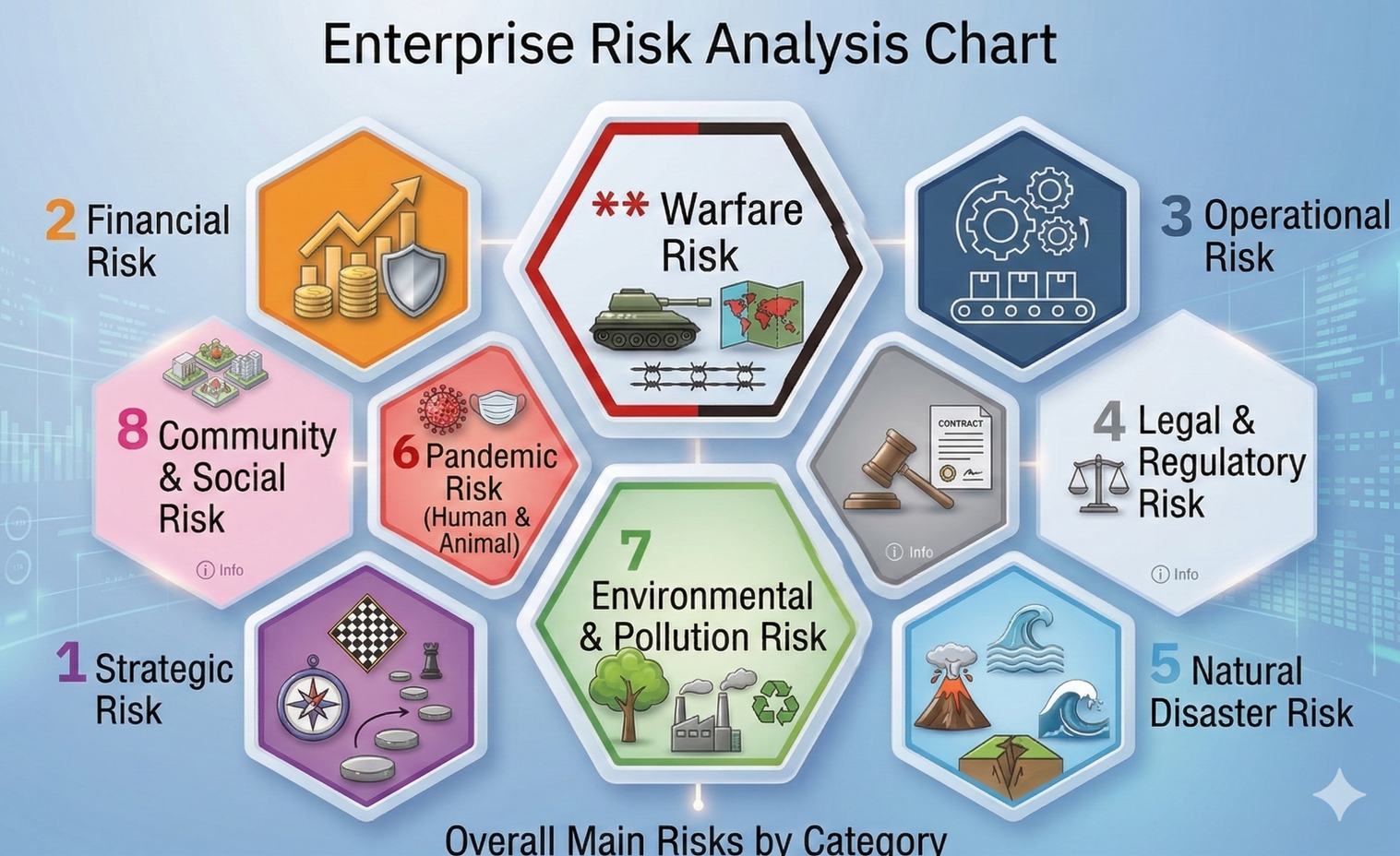
(1.3) Define strategies and operational guidelines for risk management consistent with the risk management policy, enabling assessment, monitoring, and oversight of risk levels to remain within acceptable limits.
(1.4) Report to the Board of Directors regarding risks and risk management. The powers, duties, and responsibilities of the Risk Management Committee are as stipulated in the Risk Management Committee Charter.
(2) The Board of Directors has appointed an Audit Committee, whose members possess qualifications as stipulated by relevant laws and regulations, to perform various duties, including reviewing and/or considering financial reports, the adequacy of internal control systems, compliance with laws, the independence of the internal audit unit, the selection of auditors, and the disclosure of company information.
(3) In addition to the Audit Committee's duties in overseeing conflicts of interest, the company has also established a conflict of interest prevention policy to define guidelines for action in cases where conflicts of interest arise.
(4) The company has established a code of business ethics and an insider trading policy to prevent improper use of the company's assets, information, and opportunities. It also defines a policy for related party transactions to prevent inappropriate or non-compliant transactions with related parties.
(5) The Board of Directors has established a clear anti-corruption policy, communicated to all levels of employees within the organization and to external parties to ensure practical implementation. The Board of Directors shall also provide anti-corruption programs or guidelines, and support activities that promote and instill in all employees compliance with relevant laws and regulations. Furthermore, procedures for receiving complaints and handling whistleblowing cases have been established, with clear guidelines set forth in the anti-corruption policy. Various communication channels are provided to allow employees and stakeholders to conveniently and appropriately report tips or complaints to the company. The company has also established measures to protect whistleblowers, complainants, witnesses, and individuals providing information for factual investigations from suffering any distress, danger, or injustice arising from reporting tips, complaints, acting as witnesses, or providing information to the company.
(6) Directors and executives of the company are obliged to report to the company their interests or those of related persons that are relevant to the management of the company's affairs. The company has stipulated the duty of directors to report interests in the Board of Directors Charter, requiring any director to promptly inform the company if they have an interest in any transaction with the company or if there is a change in their shareholding proportion in the company.
Principle 7: Ensure Disclosure and Financial Integrity
(1) The Board of Directors shall oversee that the company and its subsidiaries (if any) have accounting systems, financial reporting, and financial statement review processes that comply with relevant rules and practices, and shall ensure that the company discloses various information, including company information, financial information, and important general information, accurately, sufficiently, timely, and in accordance with relevant laws, regulations, and rules.
(2) The Board of Directors is responsible for preparing the annual report, the annual registration statement (Form 56-1), and the company's financial statements. These are prepared in accordance with generally accepted accounting standards, exercising careful judgment in their preparation, and ensuring adequate disclosure of important information in the notes to the financial statements. The Audit Committee oversees the quality of financial reports and provides opinions to the Board of Directors.
(3) The Board of Directors is responsible for overseeing the adequacy of financial liquidity and the company's ability to repay debts, and shall establish plans or guidelines for resolution if problems arise. The Board of Directors requires management to regularly monitor and assess the financial position and liquidity of the enterprise and report to the Board of Directors quarterly.
(4) The company shall establish an investor relations unit or assign a responsible person to communicate and provide information to shareholders, investors, securities analysts, or relevant agencies, as well as any individuals, to ensure appropriate, equal, and timely communication.
(5) The Board of Directors shall promote the use of information technology for disseminating information. In addition to disclosing information through the channels of the Stock Exchange of Thailand as stipulated, the Board of Directors shall also arrange for the disclosure of information in both Thai and English through other channels, such as the company's website, and ensure that the information presented is up-to-date.
Principle 8: Ensure Engagement and Communication with Shareholders
The Board of Directors recognizes and prioritizes the fundamental rights of shareholders, both as investors in securities and as owners of the company, such as the right to buy, sell, transfer their held securities, the right to receive a share of the company's profits, the right to receive sufficient information, the right to attend meetings to exercise voting rights at shareholders' meetings for appointing or removing directors, appointing auditors, approving significant transactions affecting the company's business direction, and matters impacting the company, such as dividend allocation, defining or amending the memorandum and articles of association, capital reduction or increase, and approving special items, etc. The company is committed to promoting and facilitating the exercise of shareholders' rights, including treating all shareholders equally, as follows:
(1) Information regarding the date, time, place, and agenda of the meeting shall be provided, along with explanations, supporting reasons, and opinions of the Board of Directors for each agenda item or for resolutions as specified in the notice of the shareholders' meeting or in the attached agenda documents, in a complete manner sufficient for shareholders' decision-making. The notice of meeting shall be sent to shareholders, the Stock Exchange of Thailand, and published on the company's website in accordance with relevant rules, regulations, and other laws, and shall refrain from any actions that limit shareholders' opportunities to study the company's information.
(2) Facilitate all groups of shareholders to fully exercise their rights to attend and vote at meetings, and refrain from any actions that limit shareholders' opportunities to attend meetings, such as using a convenient location for travel, by attaching a map showing the meeting venue in the notice of meeting, as well as selecting appropriate dates and times, and allocating sufficient meeting time to ensure that attending and voting are not overly complicated or costly.
(3) Before the date of the shareholders' meeting, the company shall provide an opportunity for shareholders to submit opinions, suggestions, questions, or propose additional agenda items in advance. Clear criteria for submitting questions and proposing agenda items in advance shall be established and communicated to shareholders along with the notice of the shareholders' meeting. The company shall also publish these criteria on its website.
(4) Establish criteria and procedures for minority shareholders to nominate individuals for election as company directors, and disseminate information for consideration regarding the qualifications and consent of the nominated persons via the company's website.
(5) Encourage shareholders to use proxy forms that allow them to specify voting directions and nominate at least one independent director as an option for shareholders' proxy appointments.
(6) Before the commencement of the shareholders' meeting, the Chairman of the meeting shall inform shareholders of the rules governing the meeting, the method of exercising voting rights, voting rights according to each type of share, and the method of counting votes for shareholders required to vote on each agenda item.
(7) At the shareholders' meeting, the Chairman of the meeting shall allocate appropriate time, and the company shall provide equal opportunities to all shareholders to express opinions, make suggestions, or ask questions freely on relevant agenda items before any resolution is passed.
(8) The company shall encourage all directors and senior executives to attend shareholders' meetings to answer shareholders' inquiries.
(9) Arrange for separate voting on each item at the shareholders' meeting in cases where an agenda item contains multiple sub-items, such as the agenda for appointing company directors.
(10) The company shall support the use of ballot cards to ensure transparency and verifiability in vote counting.
(11) The company shall arrange for an independent person to assist in counting or verifying votes for each agenda item and disclose the results to the meeting, which shall be recorded in the minutes of the meeting.
(12) After the shareholders' meeting concludes, the company shall prepare minutes of the meeting that accurately and completely record essential information, including important questions, comments, and suggestions, to allow shareholders to review them. Furthermore, the company shall publish the voting results for each agenda item, as well as the minutes of the meeting, on its website for shareholders' consideration.
(13) The company shall submit a copy of the minutes of the shareholders' meeting to the Stock Exchange of Thailand within 14 days from the date of the shareholders' meeting.
(14) Promote the company's use of technology in shareholders' meetings, including shareholder registration, vote counting, and result display, to ensure quick, accurate, and precise meeting proceedings. The company shall regularly review its good corporate governance policy annually to align with current circumstances and the company's business.
Other CG Performance & Outcomes
Awards and Past Achievements of the Company
As a result of the outstanding business performance and effective management of CFARM, the company has been honored with awards and recognition from both government and private sector organizations, as listed below.
• Excellence in live chicken weight assessment at the processing plant in 2025.
• Production of premium-quality chicken (feet) during 2023–2025.
• Recognized as a model establishment for outstanding social security fund contributions in 2023.
• Recognized as an outstanding establishment for employing persons with disabilities in 2022.
• Recognized as an establishment participating in the 'Good Labor by Sufficiency Economy Philosophy' project in 2022.
• Implemented drug management within the establishment under the White Factory Project Level 3 in 2020.
Community Support Projects
• Lunch Program for Children in Surrounding Communities: CFARM has implemented a program to provide lunch to children in nearby communities, ensuring they receive proper nutrition.
• Children's Day Scholarship Support: The company has provided scholarships and supported Children's Day activities to promote educational development and the well-being of children in the community.
• Community Activity Support: CFARM continuously participates in and supports various community activities to contribute to social development and the well-being of the local area.