

Risk Management · 2025
In this section3 topics
Risk Management Policy & Plan
Policy & Plan Description
Chuwit Farm (2019) Public Company Limited has systematically established an enterprise-wide risk management policy. A Risk Management and Sustainability Governance Committee has been formed to develop policies and systems for assessing various risks, both those arising from external factors and from internal management and operations, to achieve the organization's main strategic objectives clearly and comprehensively, effectively covering overall organizational management, systematically linked with internal control and internal audit, and creating added value for all stakeholder groups, including business partners (business partners, creditors, debtors, and competitors), employees, shareholders, communities, society, economy, and the environment, to lead to sustainable operations and maximum benefit for the community, society, and the nation. The company has established guidelines for managing and controlling risks to an acceptable level, communicated and organized workshops for employees to raise awareness of the importance of risk management, the company's risk management process, and to promote risk management as part of the organizational culture.
Objective
The company recognizes the importance of risk management and has therefore established a consistent risk management policy, risk assessment, risk review, and risk mitigation plan. This enables the company to manage the organization towards achieving its goals, building confidence and stability in business, environmental aspects, and good corporate governance, for the maximum benefit of the company's stakeholders, as well as for adapting and preparing for new situations that may arise at any time.
Scope
The Risk Management Policy falls within the scope of responsibility of executives, directors, and all levels of personnel within the company. The Risk Management Policy is systematically developed and adheres to international standards, while also aligning with strategic plans, operational plans, and relevant legal regulations pertaining to the company.
Definition
Risk refers to various undesirable events or circumstances that may occur, posing obstacles and impacting the organization's objectives or goals.
Principles and Guidelines for Risk Management
The Risk Management Policy and the company's acceptable risk levels must be consistent with the company's strategies, strategic plans, operational plans, and relevant legal regulations. For risks that impact operations or affect the achievement of the company's goals beyond acceptable levels, the company must have a risk mitigation plan to manage them promptly and continuously.
Risk Identification and Assessment Process
To achieve the organization's objectives, goals, and sustainable success, the company emphasizes collaborative enterprise-wide risk management by identifying and assessing risks from all departments in a bottom-up approach. This ensures that potential risks can be truly and comprehensively identified and assessed in both the short and long term. Furthermore, various situations are monitored to prepare for responding to changing factors, so that all departments understand and can cope with uncertain situations and/or mitigate potential impacts on both the organization and all stakeholders, enabling the company to continue its operations sustainably.
Risk Analysis
The company has defined categories of risks, comprehensively considering both internal and external factors that have occurred or may occur and could impact operations or hinder the achievement of the company's goals, covering a total of 8+1 areas, namely:
1. Strategic Risk
2. Operational Risk
3. Financial Risk
4. Legal or Regulatory Risk
5. Natural Disaster Risk
6. Human and Animal Epidemic Risk
7. Environmental and Pollution Risk
8. Community and Social Risk
9. War Risk
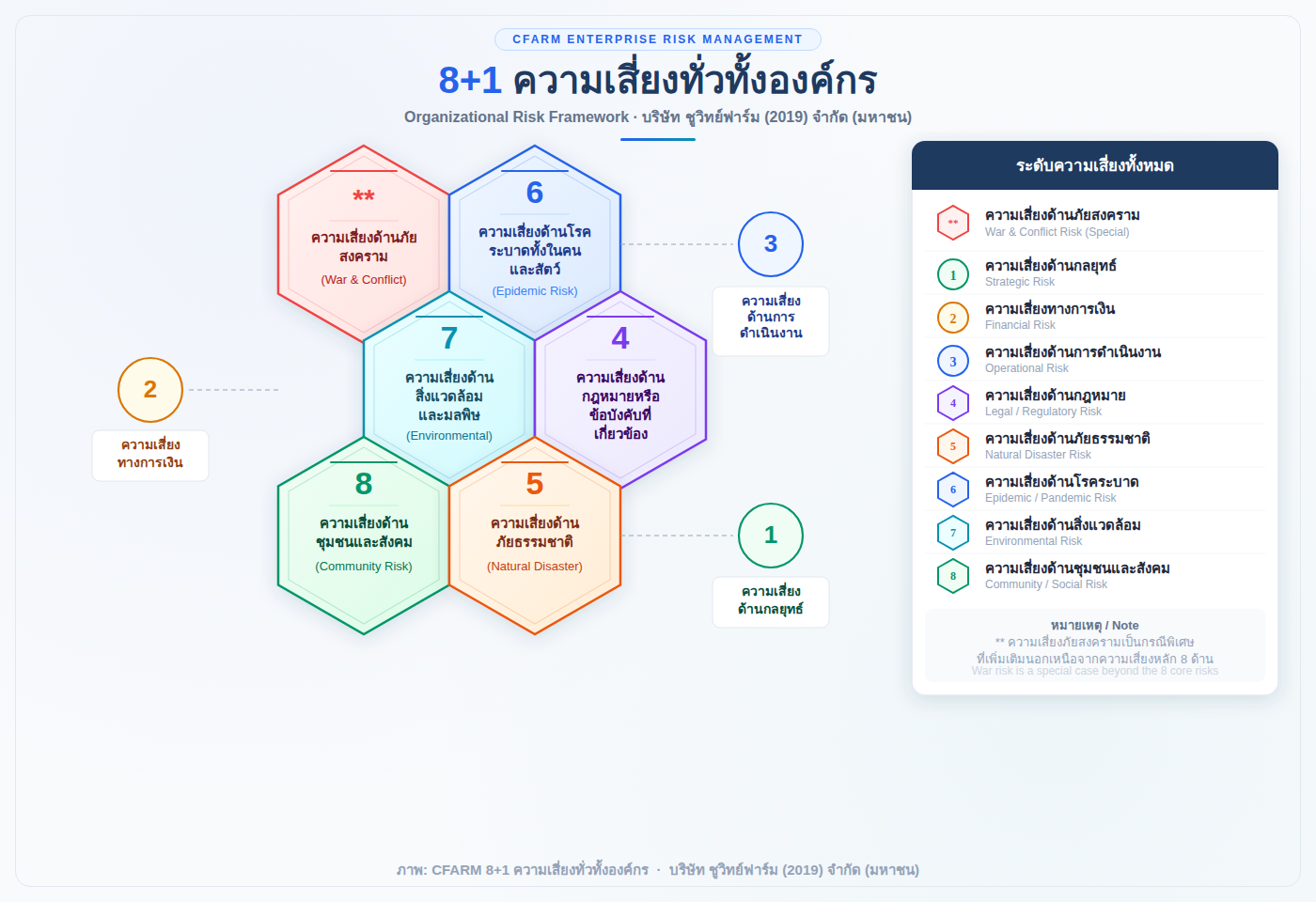
Risk Management
The company assesses the level of risk across all 8 areas that impact operations and develops risk mitigation plans for each area through the Risk Management Working Group, which comprises executives, managers, and operational staff from each department, to ensure that the risk mitigation plans are adequate and comprehensive. Furthermore, all personnel within the organization must consistently adhere to the risk management policy and plans.
Monitoring and Review
1. The Risk Management Working Group assesses, reviews, and monitors risk issues and risk mitigation plans once a month, and presents them to the Risk Management and Sustainability Governance Committee once a quarter.
2. The Risk Management and Sustainability Governance Committee assesses and reviews the Risk Management Policy at least once a year or as appropriate, by evaluating, reviewing, and monitoring risk issues and risk mitigation plans once a quarter, and reporting to senior management, the Audit Committee, and the Board of Directors for approval of the updated Risk Management Policy and the monitored risk issues, ensuring risk management remains at an acceptable level.
Promotion, Communication, Response Guidelines, Expectations, and Needs
The company encourages all personnel within the organization to be aware of and understand potential risks, whether arising from internal or external factors. It promotes risk management as an integral part of the organizational culture, and views risk management as a duty for all personnel to adhere to and follow systematically. Furthermore, the company regularly organizes training sessions on risk management, including relevant legal regulations.
Risks to the Company's Business Operations
Risk Register
| Risk Name | Risk Characteristics | Consequences | Management Measures | Related Risk Factors |
|---|---|---|---|---|
| Risk of infectious disease outbreaks in poultry | The risk of infectious disease outbreaks in chickens that may affect the quantity and quality of chickens raised on the farm. There are various types of poultry diseases, such as Newcastle disease, infectious bronchitis, and fowl cholera, among others. These infectious diseases often have a negative impact on the health and growth of chickens. Furthermore, some poultry diseases can be transmitted to humans, such as avian influenza, which is severe and can spread spread rapidly, affecting the | Categorized by risk level Risk Level 1 (On-farm Level): In the event of a chicken disease outbreak, the Department of Livestock Development may issue an order to cull chickens raised on farms located less than 10 kilometers from the infected farm, following confirmation of infection from laboratory results. This would result in the company losing all revenue from that production cycle and incurring costs for cleaning and disinfection (Decontamination). Risk Level 2 (Inter-farm Level): In the event of a severe animal disease outbreak, and the Department of Livestock Development detects an epidemic on a particular farm, the Department may issue an order to cull the infected animals and prohibit the movement of poultry and poultry carcasses within a 10-kilometer radius. This would result in the company's farms, even if uninfected but within the control radius, being unable to send chickens to processing plants as scheduled or unable to introduce new batches of chicks, thereby disrupting the operational cycle. Risk Level 3 (Community Level): Should the epidemic spread widely at the community level around the farm, it could cause public health panic (especially for zoonotic diseases such as avian influenza), affecting community confidence. This could lead to complaints demanding temporary suspension of operations, as well as difficulties for employees and laborers traveling to work in the affected area. Risk Level 4 (Provincial Level): If the province where the farm is located (e.g., Buriram Province) is declared a "Disease Control and Surveillance Zone for Animal Epidemics," it would severely impact the overall supply chain. Integrators may implement policies to delay or cease the delivery of chicks for rearing in that entire province, causing the company's primary revenue to halt for an extended period (Prolonged Downtime), which would affect the company's liquidity and cash flow. Risk Level 5 (National Level): Should a national-level outbreak occur, trading partners may announce a suspension of chicken meat and product imports from Thailand, leading to a slowdown in the broiler industry. Integrators may be compelled to significantly reduce production capacity or alter contract farming terms, which would inevitably have a severe negative impact on the company's revenue, net profit, and annual performance. | 1. Risk Management Measures Level 1 (On-farm Level):
| 1718 · Description: Pandemic risk · Info category: STRATEGIC_RISK |
| Risk from natural disasters and accidents | Risk of natural disasters and accidents Risk of El Nino phenomenon Risk associated with the La Nina phenomenon | Impact from natural disasters. The El Nino phenomenon results in hotter-than-normal weather and less rainfall, posing risks of drought and water scarcity for chicken farming. The La Nina phenomenon leads to increased rainfall, posing risks of floods, flash floods, and tropical cyclones, especially during the rainy season. This may cause damage to the company's assets and could result in loss of life and property for employees working on the farms. Furthermore, as the company raises broiler chickens for contractors, there may be risks to the chickens. during the raising, feed animals and veterinary supplies, which may significantly impact efficiency and effectiveness of farming, which may affect the operational performance of the company |
| 750 · Description: Climate change and disasters · Info category: OPERATIONAL_RISK · 751 · Description: Impact on the environment · Info category: OPERATIONAL_RISK |
| Risks from geopolitical conflicts and border situations | External factors that cannot Control can The company operates a livestock farm business, specifically a broiler chicken farm at its facility. The farm is located in Buriram Province, which borders a neighboring country along the Thai-Cambodian border. This exposes the company to the risk of being affected by geopolitical uncertainties, political tensions, or border disputes. |
|
| 733 · Description: Business operations of partners in the supply chain · Info category: STRATEGIC_RISK · 749 · Description: Safety, occupational health, and working environment · Info category: OPERATIONAL_RISK · 755 · Other name: Operational Risk · Description: Other · Info category: OPERATIONAL_RISK |
| Revenue did not meet the plan, failing to achieve financial objectives, which impacted earnings per share. | The company's revenue not meeting planned targets may result in the inability to achieve financial objectives, which would directly impact the company's net profit and lead to a decrease in Earnings Per Share (EPS). | 1. Revenue not meeting projections impacts performance. If a company's revenue falls below expectations, it may be due to several factors, including uncontrollable external and internal factors. such as economic downturns, decreased product demand, increased production costs, or natural disaster issues. These factors prevent the company from achieving its profit targets. 2. Impact on Net Profit and Earnings Per Share (EPS). Decreased revenue leads to a reduction in gross profit, especially if fixed costs remain at the same level. When net profit decreases and the number of company shares remains constant, Earnings Per Share (EPS) will decrease. A decrease in EPS may lead to a decline in investor confidence and could affect the company's stock price. |
3.1 Cost Management The Production Control costs indirect raw materials, labor efficiency management 3.2 Improve Efficiency in process production through industrial agricultural technology, including Farm On-line, Farm Management, and IoT effectively and efficiently. 3.3 Increase Efficiency labor by implementing technology and artificial intelligence or System automation to be assist Reduce costs utilization expenditure in terms of labor 3.4 Strengthen work systems with international ERP for developing work systems, reporting, and statistical systems for analysis and synthesis to achieve management goals and adapt to current situations. 3.5 Energy management towards alternative and renewable energy for sustainable growth potential. | 728 · Description: Volatility in the industry in which the company operates · Info category: STRATEGIC_RISK · 729 · Description: Behavior or needs of customers / consumers · Info category: STRATEGIC_RISK · 733 · Description: Business operations of partners in the supply chain · Info category: STRATEGIC_RISK |
Risks to Securities Holders' Investment
Risk Register
| Risk Name | Risk Characteristics | Consequences | Management Measures | Related Risk Factors |
|---|---|---|---|---|
| Investment risk that the company cannot guarantee the share price will remain at the same level or significantly decrease. | Stock prices may fluctuate due to several uncontrollable factors of the company, such as
| 1. Decreased investor confidence
2. Difficulty in fundraising
3. Impact on shareholder value and dividends
| The company has implemented measures to mitigate risks as follows: 1. Manage cost control and enhance operational efficiency. 2. Reduce unnecessary expenses to maintain profitability. 3. Develop long-term return investment projects to build business stability and reduce stock price volatility. 4. Build investor confidence by communicating information transparently. 5. Promote sustainable investment to enhance attractiveness for long-term investors. | 769 · Other name: Investment risk factors for which the company cannot guarantee that the share price will remain at the same level or will not significantly decline. · Description: Other · Info category: HOLDER_RISK |